AI, Curriculum, and the End of "Coffee Charisma"
Sep 02, 2026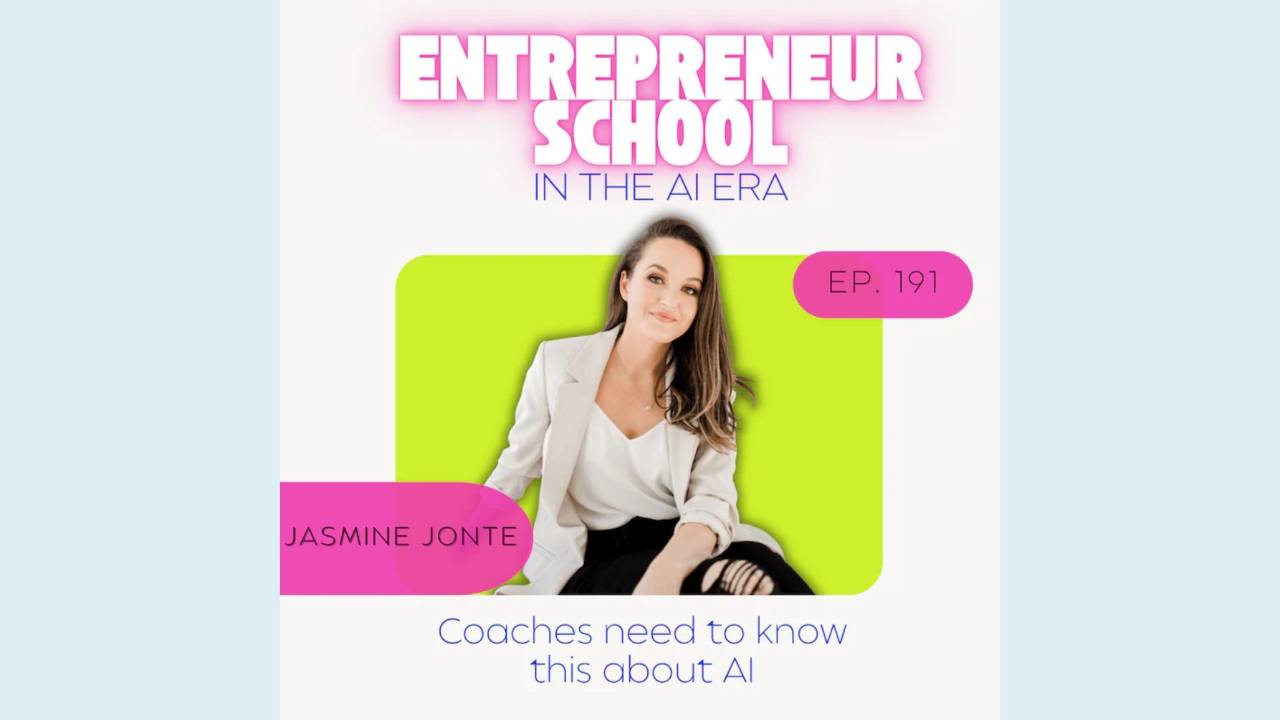
"You can't skirt by with coffee charisma and a personal brand. You actually have to deliver results for people." ☕Jasmine Jonte, founder of Cre8tion, dropped that line on Kelly Sinclair's Entrepreneur School podcast — a show entirely dedicated to figuring out how AI fits into the businesses we've already built. It's a fitting summary for a conversation that gets refreshingly specific about where AI actually belongs in course design, and where it doesn't. Let's get into it. 🎯
Q: How is AI actually shifting client expectations for coaches, creators, and educators?
A: Jasmine's framing here is sharp: information was never really what people were paying for — it's just become impossible to pretend otherwise. With AI making raw information instantly accessible to anyone, buyers are naturally asking a harder question: why would I pay a coach or a course when I can just ask an LLM directly?
Her answer isn't that expertise no longer matters — it's the opposite. The mistake many experts made back in 2020 was assuming information alone equaled transformation. That assumption doesn't hold anymore, and AI has simply made the gap between "informational" and "transformational" too obvious to ignore.
Q: Does this shift look the same across every audience?
A: No — and Jasmine's advice here is a good reset for anyone assuming there's a universal AI playbook: know your ideal client, because this shifts significantly depending on who you serve.
Her contrast: a client called Entrepreneurial Performance Labs licenses an assessment and curriculum to universities — their end users are college students with genuinely high expectations for interactivity and application. Compare that to a real estate investing program Jasmine's team built for clients in their late 60s and 70s — a very different bar for what "engaging" even means.
Even with that caveat, two broad patterns are showing up consistently across her client base:
- Shorter videos. Six to ten minutes, on the high end, for video-based curriculum.
- A shift away from traditional static resources (workbooks, manuals, spreadsheet calculators) toward interactive AI tools — custom-built based on the client's specific curriculum, letting students apply what they're learning immediately, sometimes without watching a single video first.
Q: What does "personalization at scale" actually mean in practice?
A: This is where Jasmine gets genuinely animated. Feed AI your training content, your client stories, your real examples — the right amount, not an overwhelming dump — and it becomes possible to give students access to your knowledge, your process, and (in a sense) your expertise 24/7, without requiring your personal time.
There's a nuance worth catching here, and Jasmine names it directly: AI can sometimes remember things more reliably than you can in the moment. A human expert might forget a specific detail that would help a specific client at a specific time — AI, trained well, won't.
⚠️ Her important caveat: this isn't an either/or. Jasmine is explicit that she still believes deeply in human-to-human connection — "AI can't be coded with intuition." The goal isn't replacing the expert; it's freeing up the expert's time and energy to stay in their actual zone of genius — the intuition, nuance, and real connection that AI genuinely can't replicate.
Q: Doesn't relying on AI risk making an expert feel less valuable or replaceable?
A: Kelly raised this fear directly, and both she and Jasmine push back on it hard. Kelly's own observation from clients building AI tools on her platform: when AI handles the basic FAQs and first-draft work, clients show up to live calls and coaching sessions already further along — which means the actual human expert gets to go deeper into strategy, nuance, and intuition, instead of spending that time re-explaining fundamentals.
✅ The reframe worth sitting with: using AI well doesn't shrink your value — it removes the friction, so the parts of you that genuinely can't be automated get more room to show up.
Q: How much of a program should actually be AI-supported? Is there a target ratio?
A: No universal formula — Jasmine's answer depends entirely on the subject matter itself. A few real examples she shared:
- Real estate investing: AI can't design a blueprint (architects are still very much needed), but elements like tenant communication were well-suited to AI support — landing somewhere in the middle of the spectrum.
- A "revenue roadmap" offer — helping booked-out 1:1 experts figure out their next leveraged offer (mastermind? course? group coaching?) — draws on frameworks refined across hundreds of expert businesses. Jasmine estimates this process runs roughly 55% AI, 45% human insight and intuition from her team's specific, proven frameworks.
- Intuition-based training programs — nearly 0% AI, because the entire point of the transformation is developing something AI fundamentally can't replicate.
🎯 The consistent underlying question, regardless of ratio: who's your ideal client, and what are you actually teaching them? That answer should drive the AI-to-human balance — not a generic industry benchmark.
Q: How should creators think about disclosing or positioning their use of AI to clients?
A: Practically and honestly, with the specifics depending heavily on the audience. Jasmine's blunt first piece of advice: put it in your contracts — talk to a lawyer about disclosure clauses.
Beyond the legal side, she's noticed a clear pattern in client reception:
- Clients in more logistics-driven work (her example: professional service providers) tend to be fully on board — AI just means faster delivery with less friction, and there wasn't much resistance to begin with.
- Clients in feelings-based, intuitive niches (she named tarot education and intuition-training specifically) tend to have more friction. The concern is less about the technology itself and more about a fear that relying on AI could actually make the transformation harder to deliver — for example, a tarot reader worried that leaning on AI to interpret cards might undermine their ability to read intuitively without it.
✅ Her approach to that resistance: it comes back to marketing — specifically, framing the actual benefit clearly and directly addressing the real (not assumed) risks, rather than avoiding the conversation.
Q: Kelly raised an interesting point about AI removing psychological barriers to buying — can you say more about that?
A: This might be the most quietly useful insight in the whole conversation. Kelly shared a personal example: she'd always resisted macro-tracking for nutrition — not because she didn't want the result, but because she didn't believe she'd actually follow through on the tedious tracking involved. Once she recognized that AI could handle the tracking system for her, the belief barrier disappeared, and so did her resistance to the offer itself.
Jasmine connected this directly to her own agency's success: her clients never object based on doubting whether the end program will get results — because they know Jasmine's team is doing the heavy lifting. The parallel with AI is the same: it's not "done for you," but it removes enough friction that the belief barrier ("I don't think I could actually do this consistently") disappears. For experts, the real strategic question is: what does my ideal client actually resist about doing the work — and can AI remove that specific friction point?
Q: Do you have a specific example of a client reimagining an existing program around AI?
A: Yes — and the Entrepreneurial Performance Labs example is a great illustration. Their program assesses students across 13 entrepreneurial traits and is meant to end in a personalized improvement plan. The original version left students to synthesize their own results into a plan entirely on their own — and feedback showed the program simply wasn't engaging enough.
Jasmine's team built a multi-step AI experience: students input their assessment results, answer a few qualitative questions about their own interests, and the AI generates a genuine first-draft performance plan for them — turning a passive, "figure it out yourself" ending into an active, personalized deliverable.
🚀 A second example she shared: a long-standing real estate coach who'd been teaching the same core process for a decade recently rebuilt her entire program from the ground up — infusing AI into nearly every step and restructuring it into a three-year ascension model. Jasmine's respect for this move is genuine: most creators build a program once and assume it's finished. Her pointed reminder: "Somebody's marketing that bad boy. Somebody's selling that bad boy, and you got to keep it up with the time." Passive, static programs are a myth — the ones surviving and thriving are the ones willing to keep iterating.
Q: Is there a risk in building an entire business around teaching AI tools specifically, given how fast they change?
A: A real one, and Jasmine draws a useful parallel: it's structurally similar to teaching social media or Facebook ads — anything tied to a specific, fast-moving platform requires a business model built for continuous iteration, not a one-and-done curriculum. If you're teaching a tool that changes monthly, your program has to be designed to evolve in near-real-time alongside your students, not as a fixed asset you build once.
Q: What's your closing takeaway on what actually drives results, before and after AI?
A: Jasmine's answer ties the whole conversation together, and it's a principle that predates AI entirely: "It's their job to do the work, but it's your job to make the work easy to do."
Her sharpest, most memorable point: the clients thriving right now aren't necessarily the ones teaching AI — they're the ones with genuinely strong lifetime value, built on real results and ascension, not a single offer sold indefinitely. As she put it, relying on one offer forever is "quicksand." The formula hasn't actually changed — make the path to results as fast and frictionless as possible, and retention, referrals, and ascension naturally follow.
The Bottom Line
AI hasn't replaced the value of real expertise — it's exposed which experts were only ever offering information, and rewarded the ones who deliver genuine transformation. Know your specific audience before deciding how AI-heavy your program should be, use it to remove friction and personalize at scale (not to replace human connection entirely), and remember that no program — AI-powered or not — is ever really "done."
Curious how AI could actually fit into your own program? 🚀 Grab Jasmine's free tool, CourseFlix, at cre8tion.co/netflix for a personalized quiz on making your program more engaging — or head to cre8tion.co to learn more.
Enjoyed this conversation? Subscribe to Entrepreneur School for more on navigating AI in the business you've already built.
Join Thousands of Course Creators + Get FREE Weekly Tips in your Inbox
The folks on my list get the goods, by which I mean... insider scoop on the biz, personal life updates, and first chances to join me in new opps. You're in good company. No spam, ever.
We hate SPAM. We will never sell your information, for any reason.
