Are Online Courses Dead? What's Really Happening Right Now
Apr 19, 2026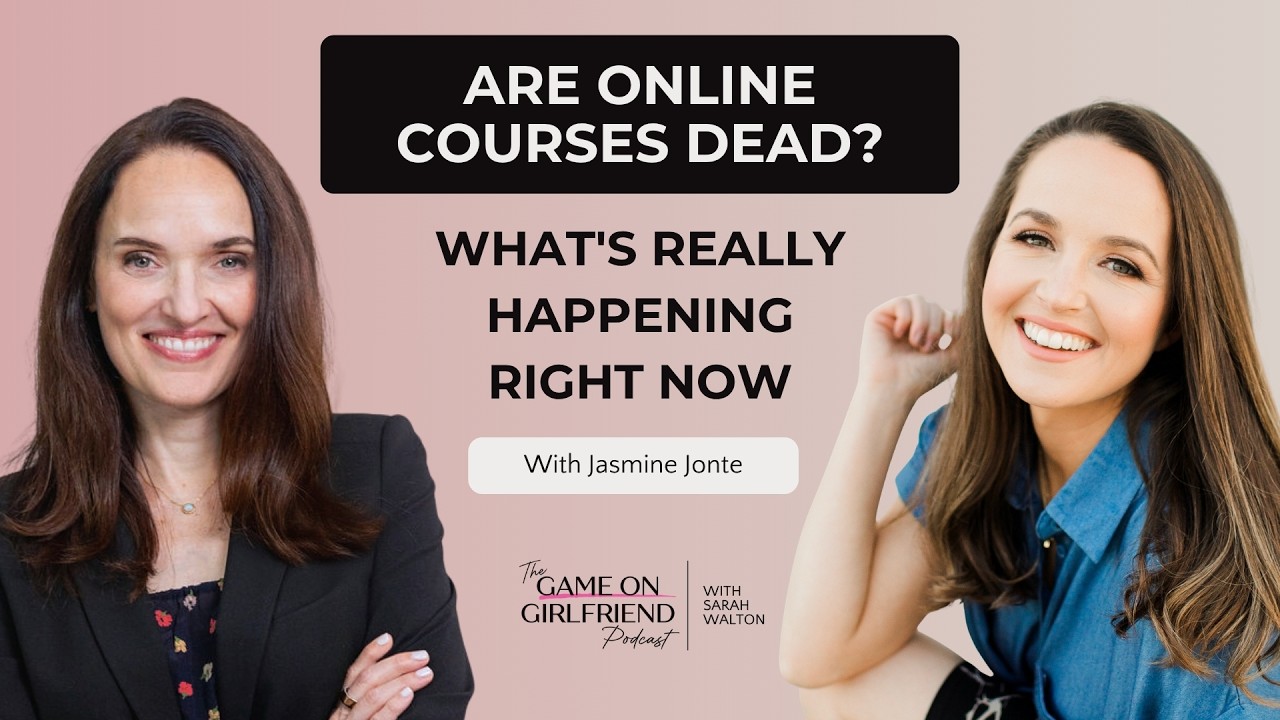
Big names in the online course space have been closing up shop lately, and the internet has, predictably, spiraled into panic. Jasmine Jonte, founder of Cre8tion, joined Sarah Walton on the Game On Girlfriend Podcast to answer the question everyone's been asking directly: are courses actually dead?
Spoiler: no. But the reasons why are more interesting than a simple yes-or-no. Let's get into it. 🎯
Q: Some big-name course educators have shut down their programs. Does that mean courses are dying?
A: No — and Jasmine backs this up with real data, not just optimism. She points to a colleague who runs one of the industry's leading checkout platforms, processing billions of dollars in transactions that continue to grow. The expert and education space isn't going away.
What's actually happening is more specific: the standard has risen. A few years ago, halfway-decent Zoom recordings could pass as a legitimate course. That bar no longer clears, because buyers have gotten more sophisticated. As Jasmine puts it: "That doesn't mean they're gone. It just means you need to be willing to do better."
Q: Why did specific big names — like Amy Porterfield — actually step back from courses?
A: Jasmine's breakdown here is sharp and specific, not just speculative. Two factors compound against a business like that:
- The word "course" itself has narrowed in perceived value. People increasingly associate "course" with self-paced, no-access-to-the-expert content — and self-paced info products specifically are losing power in many niches, because buyers no longer believe information alone equals transformation.
- Teaching people how to build courses is itself a saturated niche. If your entire brand is built around "I teach the course-building method," and the broader market has soured on the exact format you're known for, that's a much harder position to hold than a niche with a specific, painful problem to solve.
🎯 The key distinction: it's not that courses stopped working — it's that a business built entirely around evangelizing one specific format, in an increasingly crowded niche, became harder to sustain.
Q: So does format (self-paced vs. supported) even matter anymore?
A: It depends entirely on the niche — and Jasmine's counterexample is a great illustration. One of her clients, a former judge, built a fully self-paced program helping people through divorce and custody battles. No live access to him at all — and it sells extremely well, because the niche is high-pain and high-stakes. As Jasmine points out, a $500–$1,000 self-paced course is a fraction of the cost of even a couple hours of lawyer's fees — the value math works out dramatically in the buyer's favor.
Compare that to a lower-stakes, more saturated niche (like "how to build a course"), where the same self-paced format has lost a lot of its pull. The lesson: self-paced isn't dead — it's niche-dependent.
Q: If self-paced alone isn't enough anymore, what should creators actually focus on?
A: Two things, according to Jasmine:
Double down on your specific niche
Her most successful clients are, in her words, "in a niche of one." They're so specific about the problem they solve and who they solve it for that they become the obvious, singular choice — not one option among many generalists.
Think beyond curriculum to the full "leveraged offer"
Curriculum — video content, self-paced material — is just one piece. The bigger opportunity is in what Jasmine calls leveraged offers: group coaching, certifications, licensing, memberships — essentially, the experience surrounding the knowledge, not just the knowledge itself. Back in 2020, her advice was "add real experience, not just video." Today, her advice has evolved: "Make your curriculum even shorter, and make your experience even more integrated and powerful" — something AI has made significantly more achievable than it used to be.
Q: Where does AI actually help — and where does it fall short — in building and selling courses?
A: AI is genuinely useful for lightening the load on copywriting, email sequences, and landing pages — but Jasmine is blunt about its limits: garbage in, garbage out.
If you go into ChatGPT with no brand voice, no ideal-client research, and no training data specific to your business, you'll get generic output trained on the rest of the internet — which is already crowded with mediocre advice on most topics. Her recommended approach instead: interview 15–20 of your actual ideal clients, feed those real transcripts into AI, and use it to help build landing page copy from genuine language — not assumptions.
She also shared a telling pattern from her own client conversations: when people show her a ChatGPT-generated course outline, her honest read is usually "that's about 15% good on a good day." It's useful for getting unstuck and organizing initial thoughts — but it can't replace working with someone who actually knows what "good" looks like in a specific niche.
⚠️ On the "why would I pay for a course when I can just ask AI" objection: Jasmine's counter is that AI is trained on the entire internet — including a lot of mediocre, unverified advice. Learning directly from someone who's actually gotten the specific result you want is a fundamentally different (and more reliable) input than a general-purpose model's aggregate answer.
Q: What actually separates a great course from a mediocre one?
A: It depends on how you define success — selling well, or actually delivering student results. Jasmine focuses on the latter, and her answer circles back to something she repeats across nearly every conversation: know your specific ideal client, down to the format they'll actually consume.
Her range of real examples: Gen Z programs built as QR-code-linked TikTok content, and programs for clients in their 70s who, given a choice between online access, DVD, or both, chose DVD only.
But across every demographic, one principle holds: more content is not more value. Jasmine's own gut reaction to a "seven-course bundle" landing page is an immediate no — and she suspects most buyers feel the same. The goal isn't maximum content; it's the Goldilocks amount — the shortest path that still reliably gets the student the result.
Q: How does sequencing factor into all of this?
A: This is a subtle but important point: build the course around how the student learns, not how the expert originally learned it.
Jasmine flags a common trap — experts teaching the exact step-by-step path they personally took, without recognizing there might be a faster, more direct route for someone starting from scratch. The right sequence isn't necessarily the founder's original journey; it's the fastest, cleanest path to the result for someone who isn't you.
Q: If a course gets great feedback in a small pilot but doesn't sell, what's usually going wrong?
A: Jasmine's diagnostic instinct is to look at the whole funnel, not just the offer itself. Before assuming the content is the problem, check: how many people actually saw the offer? How many converted at each stage — ad views, webinar attendance, webinar-to-purchase? A great offer poured into a broken funnel just burns ad spend.
Her recommendation echoes something you'll hear across the industry for good reason: prove conversion with a warm audience first. If it converts organically with people who already know and trust you, you have real data to gauge performance before sending cold traffic into the same funnel.
Q: What's the biggest myth about making money from online courses?
A: The "sit on a beach, sip a mimosa, watch your PayPal ding" fantasy. Jasmine doesn't dismiss it as impossible — she just clarifies what it actually requires: an active digital marketing engine, run by you or by people you hire. That might mean a small team of contractors handling ads, copy, and overall marketing operations — not a "set it and forget it" system.
Her metaphor for the industry's real mechanics: it's a pot of water on a stove. Leave the heat on consistently, and it will boil — every time. But too many creators strategy-hop between challenge launches, masterclasses, and podcast funnels without ever letting one approach fully "come to a boil." The tactics all work — the inconsistency is what doesn't.
The Bottom Line
Online courses aren't dying — the bar for what counts as a good one has simply risen, and the businesses built purely around hype for the format (rather than results) are the ones struggling. Get hyper-specific about your niche, build the full experience around your curriculum (not just the videos), use AI as a research-informed thought partner rather than a replacement for real client conversations, and commit to one marketing strategy long enough to actually see it work.
Wondering whether your course idea needs a rebuild — or just a sharper strategy? 🚀 Head to cre8tion.co or talk to Jasmine's custom-built Course Flix GPT for a personalized breakdown.
Loved this episode? Subscribe to the Game On Girlfriend Podcast for more straight talk on building a business that actually works.
Join Thousands of Course Creators + Get FREE Weekly Tips in your Inbox
The folks on my list get the goods, by which I mean... insider scoop on the biz, personal life updates, and first chances to join me in new opps. You're in good company. No spam, ever.
We hate SPAM. We will never sell your information, for any reason.
