
Building an Online Program That Sells
Feb 03, 2026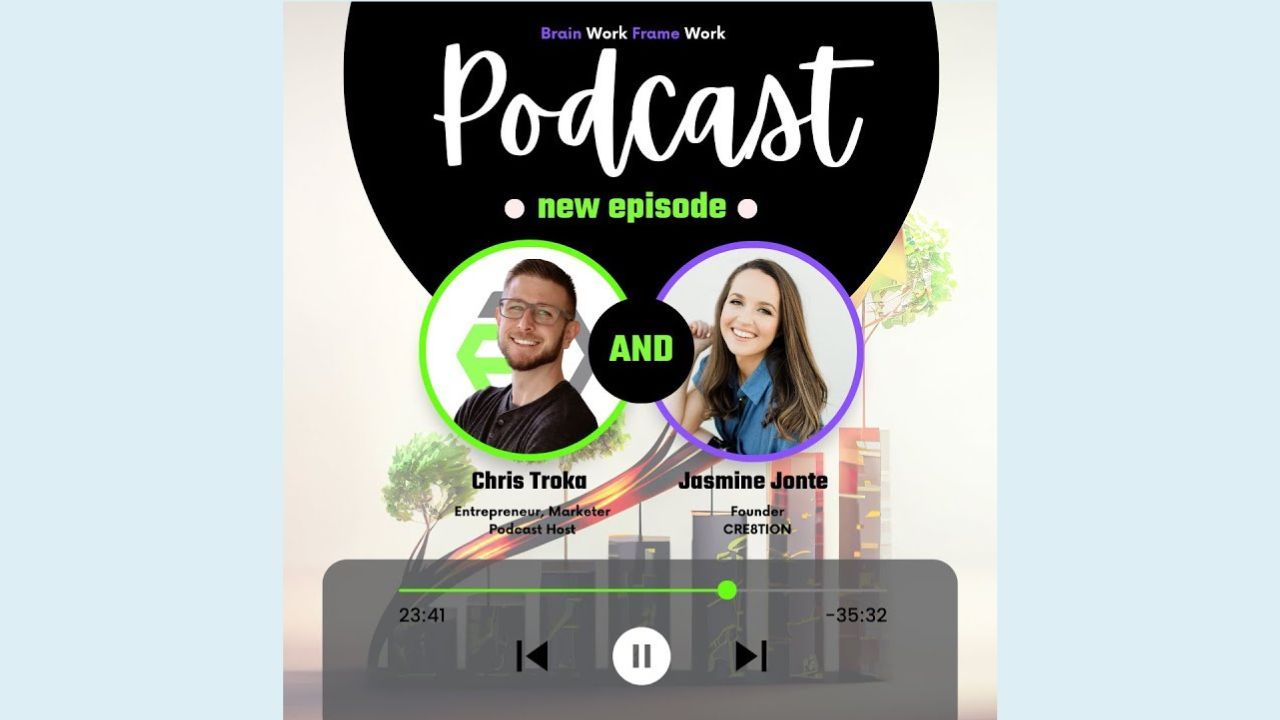
"Marketing is not a rotisserie chicken." Jasmine Jonte, founder of Cre8tion, dropped that line on Chris Troka's Brainwork Framework podcast, and it might be the single best summary of what actually makes an online program work — versus what people wish it would do. Let's break down the conversation. 🎯
Q: Is a course really the "build it once, recurring revenue forever" business model people say it is?
A: Not quite — and Jasmine draws a specific line between what's actually passive and what just looks that way from the outside. Her definition of true passive income: something like a stock market investment you check once a year and let ride. A course, by contrast, is built once — but selling it over and over again is rarely a passive act.
Whether you're running launches, keeping evergreen ad creative fresh, reaching new market segments, or maintaining SEO and content, someone is actively doing ongoing work to keep sales coming in — even if it's not the creator personally. Her memorable framing: "just because they're sipping mimosas on the beach doesn't mean somebody isn't in their Facebook ads account checking things right now."
✅ The honest version: you can absolutely build a revenue stream that requires less of your direct time than 1:1 delivery — but it's a staged transformation, not a one-time switch from active to passive.
Q: How has the course market shifted since the pandemic boom?
A: Jasmine credits a friend, Michael Hunter (of Spiffy Checkouts), with a framing she now uses constantly: in 2020, both creators and consumers were forced online simultaneously, plus government stimulus money flowed into the market — creating a genuine boom period where coaching and course businesses grew dramatically, sometimes from 1M in a short window.
But that growth came with a cost: the market has gotten meaningfully more sophisticated over time, and marketing hooks that used to convert reliably no longer do, because buyers have seen enough low-quality programs to be skeptical by default. Combined with broader economic tightening, Jasmine's observed creators who peaked around 300K.
🎯 Her read on what this means: this is a natural market cycle, not a permanent decline. Creators who stick it out and keep improving over the next three to five years will be part of "the cream that rises to the top" — those who were only in it for the easy 2021 money will naturally filter out.
Q: If someone's on a low or zero marketing budget, how should they think about getting their course seen?
A: Start with your actual goal, not a generic playbook. Jasmine's distinction: if your priority is making real revenue now, lean toward high-ticket programs or masterminds that solve a big, specific pain point — the promise needs to be tightly tied to the problem you're pulling people out of. If it's more of a legacy or impact play, organic content strategy (YouTube, Instagram, consistent value-first posting) makes more sense as a slower-build foundation.
Q: How much does "over-delivering" actually matter for referrals and repeat business?
A: Enormously — but Jasmine's honest observation is that the bar is often lower than people assume, simply because so much of the market underdelivers. Her example: a well-known PR consultant in Australia spent $250,000 with various U.S. contractors on her personal brand and business — and told Jasmine directly that Cre8tion was the only one who actually delivered what was promised. That client now sends Jasmine referral business regularly, without being asked.
Her framing on business growth ties directly back to this: there are three core levers — new leads, higher transaction value per client, and retention/repurchase/referral rate. Get that third lever right, and new lead generation becomes far less pressured, because existing clients start doing that work for you.
Q: What kinds of course topics are performing especially well right now?
A: The common thread across Jasmine's strongest-performing programs: a clear, urgent pain point the buyer has no real choice but to solve.
Her example: a divorce and custody case program, where a 500-an-hour lawyer — often producing comparable or better results for a fraction of the cost. It's a genuinely easy "yes" because the alternative (not addressing the problem) isn't optional. She mentioned a similar dynamic with programs helping local businesses (like med spas) recover from being effectively blacklisted from Google search — if your business depends on local search visibility and you've lost it, paying for a fix isn't discretionary.
⚠️ The other consistent factor: personal brand. The stronger a creator's existing brand and trust, the easier it is for buyers to say yes — partly because of proximity to the creator's energy and reputation, not just the content itself.
Q: Should course content be short and tight, or longer and more comprehensive?
A: It depends entirely on why the buyer is actually purchasing — and Jasmine draws a sharp distinction between two different buyer psychologies:
- Buyers motivated by speed ("I want the result as fast as possible") — for these audiences, Jasmine skews short and tight, giving exactly what's needed and nothing extra. This describes most of her clients' buyers.
- Buyers motivated by fear of making a mistake — for these audiences, longer lessons and more comprehensive coverage (sometimes via supplemental resources rather than longer videos) actually serves them better, because thoroughness is what reduces their anxiety enough to take action.
🎯 The underlying principle: get into your buyer's actual psychology before deciding on format — length is a strategic choice, not a stylistic preference.
Q: How do you build in a natural next offer without it feeling like a hard sell?
A: Jasmine reframes lead magnets as something that can live inside an existing program, not just as a freebie opt-in on a website. Her approach: within the current course, identify the next problem students are likely to face after this one is solved, and let students know — organically, within the content — that there's a solution ready for them when they get there.
This ties directly into what she calls implementation support — genuinely useful add-ons that help students execute faster without requiring much of the expert's ongoing time. Her concrete example: a real estate investing program that includes floor plan templates as part of the core curriculum, plus an optional paid add-on where students submit their own floor plan for a quick, ~10-minute Loom video review from the expert (or eventually, a trained team member) — a small, scalable service that deepens the offer without adding significant time burden.
Q: What actually drove your early growth as a founder?
A: Genuine, consistent immersion — even in passive forms. Jasmine came into entrepreneurship with essentially one transferable skill (teaching) and no existing knowledge of marketing, sales, or pricing. Her approach: binge-listening to business and marketing podcasts during ordinary daily tasks — walking the dog, doing dishes — even without formally taking notes, because repeated exposure sinks into the unconscious mind over time, something her education background made her especially attuned to.
Her recommendation for others: go beyond generic business podcasts and find niche-specific content that overlaps two things you care about — for example, marketing content specifically for your industry, rather than marketing content in general.
Q: How do you actually help different types of learners retain and apply what they learn?
A: By intentionally covering all three learning styles rather than defaulting to one:
- Visual learners — manuals, diagrams, and clear frameworks that show the big picture
- Auditory learners — private podcast feeds they can consume passively, on the go
- Kinesthetic learners — hands-on exercises where they can practice a skill in a low-stakes environment before applying it for real. Her example: giving real estate investing students a mock floor plan to complete themselves, then comparing it against an answer key, before they ever apply the skill to an actual property.
Beyond learning style, Jasmine emphasizes keeping action steps short, specific, and immediately doable — especially in short "micro" programs, where each individual lesson should end in one clear, tangible action (buy the microphone; set up the webcam; position the light) rather than a vague direction to "go get equipment."
Q: What's one thing you'd tell your younger self, looking back?
A: Double down on relationships and community sooner. Jasmine credits much of her success directly to people who've championed her and the intentional relationships she's built over time — business, ultimately, happens between people.
Her advice for anyone who feels like the newcomer in more advanced rooms: you don't need to own everything you're good at to belong — just own the one specific gift you know you bring. For her, that's teaching and program creation; she's openly candid that she doesn't know the first thing about complex ad funnel terminology, and that's fine, because it's not her value-add in that room.
The Bottom Line
A course isn't a passive income machine — it's a real business that requires ongoing, active effort to sell, even after the content itself is built. What actually drives long-term success is a genuine pain point worth solving, content matched to your buyer's real psychology (speed vs. thoroughness), implementation support that helps students go further without draining your time, and relationships built with real intention rather than transactional networking.
Ready to figure out what kind of program actually fits your business and your buyers? 🚀 Head to cre8tion.co to talk it through.
Enjoyed this conversation? Subscribe to Brainwork Framework for more real strategy on business and marketing.
Join Thousands of Course Creators + Get FREE Weekly Tips in your Inbox
The folks on my list get the goods, by which I mean... insider scoop on the biz, personal life updates, and first chances to join me in new opps. You're in good company. No spam, ever.
We hate SPAM. We will never sell your information, for any reason.
