Course Creation Secrets That Transform Businesses
Feb 18, 2026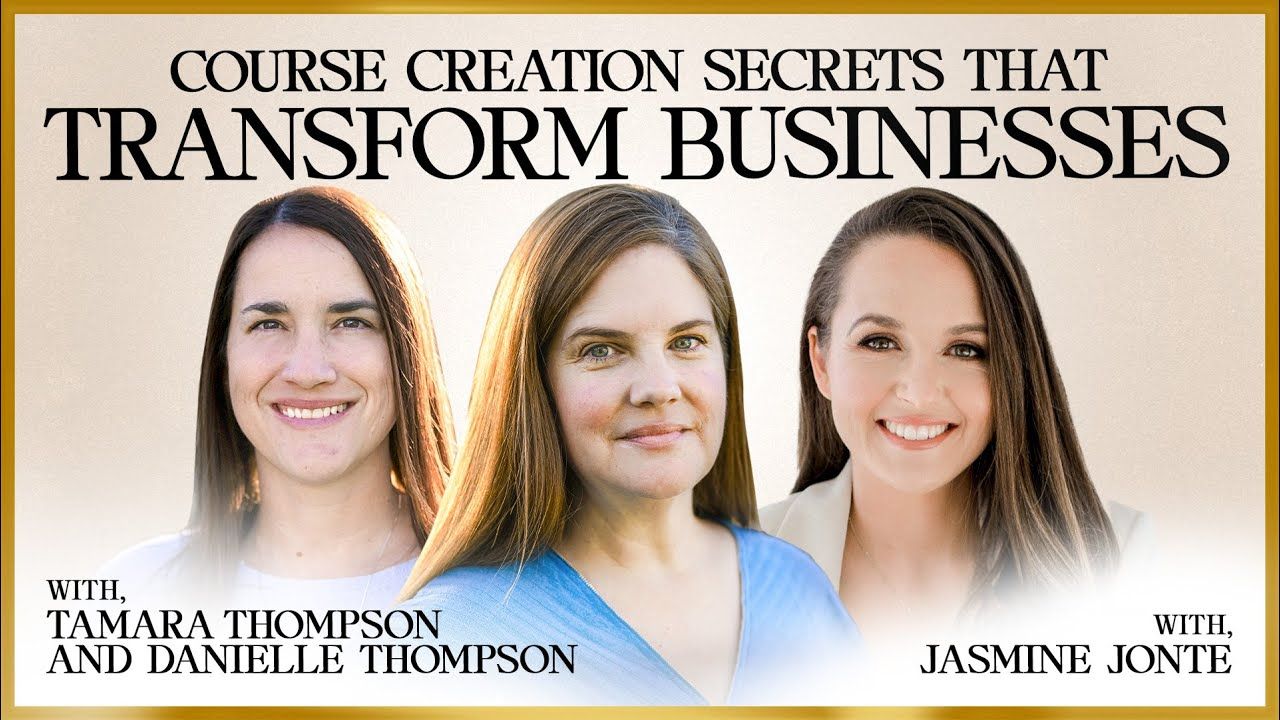
Be honest: how many courses have you bought, watched enthusiastically for exactly one day, and then never opened again? 🙋♀️
Jasmine Jonte, founder of Cre8tion, joined Danielle and Tamara Thompson on the Women Unlocking Wealth podcast to talk through exactly that problem — and what actually separates a course people finish from one that quietly becomes another tab they meant to get back to. Here's the conversation.
Q: What actually keeps students coming back to a course instead of falling off after day one?
A: Jasmine points to two levers working together: re-engagement systems and front-loaded onboarding.
On the re-engagement side, the usual suspects — email sequences, text reminders — genuinely work. But she's clear that the front end matters just as much, if not more. If onboarding does a strong job of setting realistic pacing and delivering a fast, achievable early win, students naturally start embedding the program into their routine. Skip that step, and no amount of "hey, come back!" emails will fully make up for it.
💡 One specific tactic worth stealing: private podcast feeds. Letting students access your course content the same way they access any other podcast — through an app they already open daily — removes a real point of friction that a course portal login can't match.
Q: Can you actually predict where students are going to drop off?
A: Yes — and this is a place where being proactive beats being reactive. Jasmine's team looks at completion data to spot patterns: if most students are dropping off around 20% through a program, that's a diagnostic signal worth digging into, not just a number to shrug at.
Once you know where the common drop-off points are, you can name it in advance — something like, "Most people hit a wall right around this lesson — that's totally normal, here's what to do." Combine that with automated triggers (someone hasn't logged in for 7 days, hasn't completed a module, etc.) and you've got a system actively working to pull people back in, rather than hoping they remember on their own.
Q: What's the best course platform — Kajabi, HighLevel, Kartra, or something else?
A: Jasmine doesn't have a single favorite, and her reasoning is the more useful takeaway: the decision comes down to two questions — what does the student need, and what does the business need?
Her example: HighLevel is excellent on the business-operations side (texting, automations, CRM functionality all in one place) — but its actual membership/portal experience isn't particularly polished. Her common recommendation for clients already on HighLevel: keep it for the business backend, but pair it with a separate platform for the actual student-facing experience, especially for younger audiences who expect a more mobile-friendly, visually clean interface.
🎯 The real lesson: don't pick a platform based on what's trendy — pick it based on what your specific students will actually use, and what your business needs to run efficiently behind the scenes.
Q: How do you know what format your students actually want?
A: Know your audience — literally, down to the generation. Jasmine's range of real examples here is genuinely striking:
- For some Gen Z-focused programs, her team has built physical books with QR codes linking directly to TikTok videos — because short-form, mobile-native content is simply how that audience consumes.
- For clients in their 70s, she's mailed physical DVDs — and when given the option of DVD, online access, or both, many chose DVD only.
The takeaway isn't "use DVDs" or "use TikTok" — it's that there's no universal best format. Match delivery to your specific audience's actual habits, not to what's fashionable in the course industry generally.
Q: When does it make sense to build out upsells and a full product suite versus keeping things simple?
A: Jasmine's advice: keep the main offer the main offer, especially early on. A simple upsell — something like a 1:1 add-on or a live event — is relatively easy to install without much production overhead, and that's usually enough at the start.
Once a business has multiple products that naturally build a customer journey, the strategy gets more deliberate: where in the program does it make sense to introduce the next offer, and how? Sometimes that's built into video content. Sometimes it's woven into live coaching calls — designed to both support the current transformation and plant the seed for the next one. But that level of sequencing is a "later" problem, not a "day one" problem.
Q: How does your team actually use AI in the course-building process?
A: With a hard boundary: AI is never used to generate content that isn't sourced from the client. Instead, Jasmine's team uses it as a knowledge-processing tool — for example, if they're writing Module 4 and remember the client mentioned something relevant during a Module 1 interview months earlier, AI (trained on that specific client's own material) can surface the connection instantly.
Her caution for creators trying to DIY this with general-purpose AI tools: if you don't already know what "good" looks like, AI doesn't either. Her team can use AI effectively because they've built over 100 programs and have a clear internal standard to train against. Someone without that reference point, working alone with ChatGPT, often ends up with what she calls "a really big info dump" — technically generated, but not actually well-structured.
Q: Can the same curriculum be used for more than just selling to individual customers?
A: Absolutely — and this is one of the more valuable structural ideas in the conversation. Jasmine described building a single training (in this case, a tax strategy for CFOs) that gets deployed three different ways: sold directly to individuals, used to train an internal team delivering the strategy 1:1, and licensed out to other CPA or CFO firms to train their teams.
The curriculum itself often doesn't change much — what changes is the intro or onboarding experience wrapped around it for each audience. This same model extends naturally to franchises: build the SOPs and training once, then deploy it across every location.
Q: What's a real example of a course creating outsized impact for a business?
A: Jasmine pointed to Bridget, CEO of Biddy Tarot — a leading tarot education company. Bridget's team had historically sold low-ticket offers (around $30 memberships), typical for the spiritual education niche, and were nervous about launching their first high-ticket program.
Cre8tion helped them launch a program roughly 10x their previous highest price point — and the launch dramatically exceeded expectations. Part of what made it work wasn't just the content (Bridget already had that dialed in) — it was the experience design around it: 1:1 calls, group calls, peer practice, a graduation experience, and a standout feature Jasmine is especially proud of — a matchmaking system that pairs each student with someone from the broader community to coach through a real three-month transformation before they graduate.
✅ Why it worked so well: students didn't just learn the material — they left the program having already applied it with a real client, building genuine confidence (and a built-in case study) before ever selling their own services.
Q: How does this apply to authors and thought leaders with a book already out?
A: Jasmine highlighted authors like Tiffany Yu (Diversibility) and Candy Valentino (Wealth Habits) as examples of a common gap: a book communicates a message, but it doesn't necessarily help someone implement the skill. A course or program becomes the natural next step — something a reader (or someone who just heard the author speak on stage) can purchase immediately, without requiring the author's direct time.
🚀 The strategic upside: it turns a one-time book sale or speaking engagement into a scalable, ongoing revenue stream that doesn't compete with the author's calendar.
Q: What exactly does a "Chief Experience Officer" do in this context?
A: Jasmine's CXO work focuses on the full client and customer journey — making sure what someone experiences after they buy actually matches what they were promised before they bought. That includes tech, event design (she does this work for her fiancé Brad's masterminds), and close collaboration with marketing and sales teams to keep expectations aligned end to end.
Her favorite part of the role, in her own words: "getting to see the creative vision for the experience... and then conducting it to execution — like the conductor of an orchestra."
The Bottom Line
Course completion isn't an accident — it's the result of deliberate onboarding, format choices that actually match your audience, smart re-engagement systems, and (when the moment's right) thoughtful upsell sequencing. A great curriculum, deployed with the right experience wrapped around it, can become a franchise asset, a licensing opportunity, or a launch that outperforms anything a business has tried before.
Curious what your own course could become with the right experience design? 🚀 Head to cre8tion.co or grab Jasmine's free guide, 10 Next Level Strategies to Make Your Program as Binge-Worthy as Netflix.
Loved this episode? Subscribe to Women Unlocking Wealth for more conversations on building businesses that scale.
Join Thousands of Course Creators + Get FREE Weekly Tips in your Inbox
The folks on my list get the goods, by which I mean... insider scoop on the biz, personal life updates, and first chances to join me in new opps. You're in good company. No spam, ever.
We hate SPAM. We will never sell your information, for any reason.
