Course Creation with a Teacher Turned Integrator
Feb 13, 2026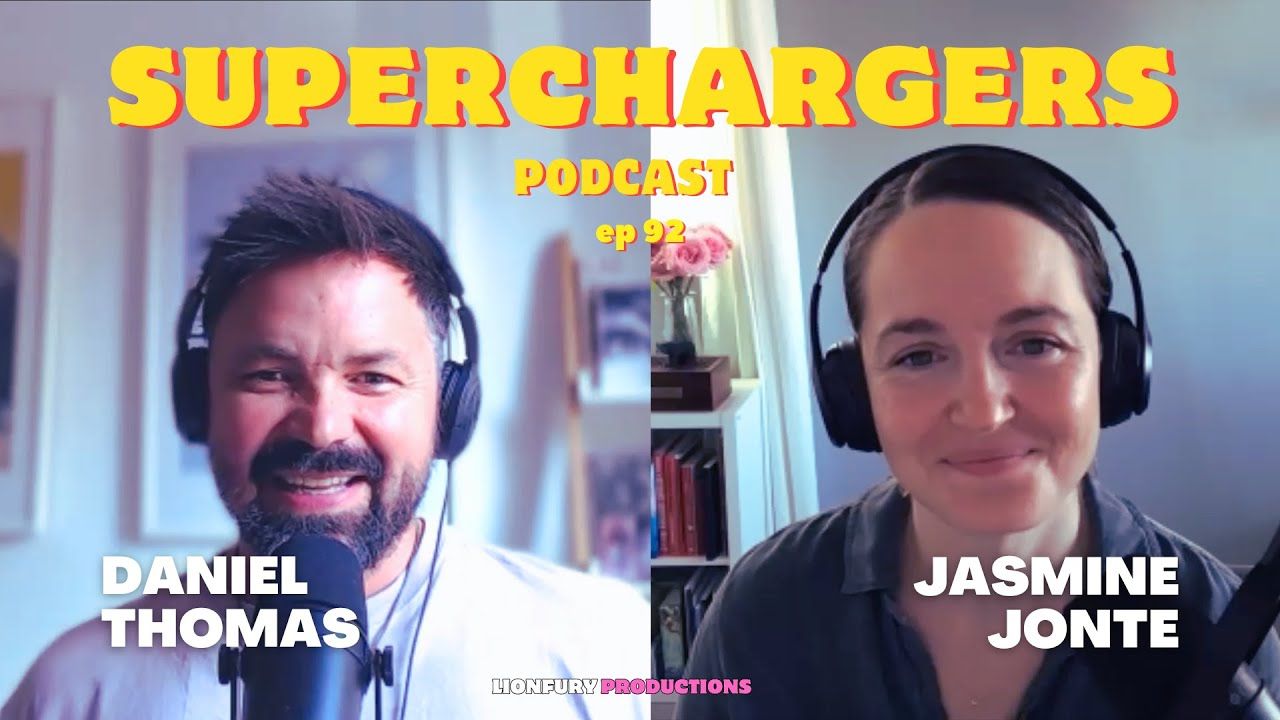
Ever sit through a 25-minute story at the start of a course lesson, quietly thinking, "just tell me what to do"? Jasmine Jonte has too — and it's exactly why she has strong, specific opinions about storytelling, attention spans, and structure in course design.
Jasmine, founder of Cre8tion, joined Daniel Thomas on the Superchargers podcast for a wide-ranging conversation covering everything from her teaching background to Ted Lasso. Here's the practical core of it, Q&A style.
Q: What did teaching actually teach you that applies to course creation now?
A: Resilience, mostly. Jasmine taught in what was, at the time, the lowest-performing school in the country — and the honest byproduct of that experience is a kind of permanent perspective shift: "I don't think I'll ever do anything that was as hard as that was." Entrepreneurship, by comparison, tends to feel manageable.
Beyond resilience, teaching young kids (she spent most of her time with five- and six-year-olds) built a specific muscle: flexibility in the moment. Plans go sideways constantly in a classroom, and you learn to adapt on the fly while still keeping sight of the actual outcome you're working toward — a skill that translates directly into building learning experiences for adults.
Q: Is the online course space actually oversaturated?
A: Jasmine pushes back on this — not by denying it feels that way, but by questioning the data behind the feeling. If you're deep in the personal development or coaching space, the algorithm feeds you an endless stream of similar creators, which distorts perception. Ask the average person on the street, and most have no real awareness of how "saturated" this space feels from the inside.
Her honest read: the space isn't shrinking, but it is going through what she calls a "crunchy middle" — a natural sorting period where people who moved online in 2020 without real conviction are starting to fade out, while people genuinely suited to it continue to grow. The cream rises to the top regardless of saturation.
Q: Is everyone capable of building a course around their expertise?
A: Technically, maybe — but Jasmine reframes the real question: it's not "could you?" It's "is this actually the best path to your outcome?"
She draws a sharp distinction between two mindsets she sees repeatedly:
- Six-figure experts tend to think of a course as the thing they need to sell.
- Seven-figure experts treat the same underlying content as an asset they can leverage multiple ways — a live event, free content, podcast material, a micro-course, and more, all built from a single core body of work.
She used her own husband as an example: content they built together once in 2020 has since been repurposed into a live event, free content, podcast material, and a micro-course — multiple revenue streams and audience entry points from one original asset.
⚠️ Worth noting: there's also a legitimate legacy-play version of this — putting your expertise into a product that outlives you, similar to writing a book. That's a valid goal in itself, but Jasmine's caution is clear: if you also want it to generate income, you need a real business model behind it, not just the hope that quality content sells itself.
Q: How much storytelling should actually be in a course?
A: Less than a lot of creators think. Jasmine described sitting through a personal branding program where individual lessons run 45 minutes to an hour, with 20-25 minutes of pure story before any actionable content appears.
Her take is nuanced, not dismissive: storytelling genuinely works — it shows students the pleasure of taking action and the pain of not taking it, which is compelling. But there's a real cost to overdoing it. Some students will love a long story. Others bought your course specifically to be told what to do, and a 25-minute narrative before the instructions feels like a barrier, not an asset.
🎯 The skill to develop: use story to create motivation, but keep it tight enough that it doesn't delay the actual instruction students came for.
Q: How do you actually structure a lesson or program from scratch?
A: Reverse engineering, all the way down. Jasmine's team starts by nailing the transformation and the specific audience first (often already defined by the time a client comes to her), then maps the outline — for example, six or seven video lessons inside a 90-minute program.
Inside each individual lesson, there's a further breakdown into a "mini outcome" — a specific, tangible result of that one lesson. All of those mini outcomes stack up to create the macro transformation the whole program promises. It's a very literal, storyboard-like process — closer to instructional design than a hero's-journey narrative arc.
✅ The core discipline: you're not building the plane in the air. There's a blueprint before there's a single word of script.
Q: Attention spans are shrinking fast — how should course creators respond?
A: Jasmine sees this less as a threat and more as a genuine creative opportunity. Video lessons are trending shorter across the board, and she's seen programs built entirely as TikTok-style micro-videos as the primary teaching mechanism.
At the same time, she's noticed a real counter-trend in audio — private podcast feeds, audio trainings, and meditations that let people consume content passively during dishwashing, driving, or other daily routines. Interestingly, she's also seeing some YouTubers swing back toward long-form content, suggesting this isn't a one-directional shift so much as a genuine pendulum.
💡 The deciding factor, as always: know your specific audience. Jasmine's team has built programs for clients in their 60s and 70s who, given options including online video, CDs, and DVDs — actively choose the physical CD/DVD version, even at the same price point, because they associate "more" (a full hour-long video) with better value. Compare that to Gen Z programs, where the entire design philosophy is: how short and tight can we possibly make this?
Q: What are the biggest reasons courses fail to actually work for students?
A: Top of Jasmine's list: content that isn't actionable enough. Experts are so deeply embedded in their own knowledge that they lose sight of how vague their instructions can sound to someone outside their head — she compares it to a fish that can't see the water it's swimming in.
Her concrete example, from a fitness program: instead of simply saying "go do your meal plan," a genuinely actionable instruction looks more like: "Use this template to create your meal plan and shopping list. Put it into Instacart and have it delivered to your house."
✅ The test: can your student clearly tell, without asking you, that they've successfully completed the step? If not, the instruction needs to be more specific.
Q: What personal practice has helped you most, both in life and in building courses?
A: Giving yourself white space. Jasmine pushes back on the instinct to fill every hour with tasks, especially during creative work like course-building. Ideas and priorities need room to surface — and that requires genuinely unscheduled time, not just more productivity.
She compared this to Stephen King's practice of setting a finished manuscript aside for weeks before revisiting it with fresh eyes — a deliberate pause that improves the final result, rather than a wasted gap in momentum.
Q: Can someone come to you with just a vague course idea, or do they need a fully formed plan first?
A: Either is fine — but Jasmine is honest about what she can and can't do for someone. No one — not her, not a marketing team — can take on responsibility for a course's ultimate success except the expert themselves. Her role is to support and execute exceptionally well, but the energy and conviction behind the content has to come from the person whose expertise it actually is.
Her team works fully virtually with clients across the US, UK, Australia, Ireland, and beyond, producing programs entirely in English regardless of location.
The Bottom Line
The skills that make someone a great teacher — resilience, flexibility, actionable clarity, and restraint with storytelling — translate directly into building courses that work. Know your specific audience's actual attention span and format preferences, structure everything as reverse-engineered "mini outcomes" building to a macro transformation, and don't forget to give yourself the white space that creative work actually requires.
Have a course idea, even a vague one? 🚀 Head to cre8tion.co — Jasmine's team can help shape it into something concrete, wherever you're starting from.
Enjoyed this conversation? Subscribe to Superchargers for more insight from founders and creators building things that matter.
Join Thousands of Course Creators + Get FREE Weekly Tips in your Inbox
The folks on my list get the goods, by which I mean... insider scoop on the biz, personal life updates, and first chances to join me in new opps. You're in good company. No spam, ever.
We hate SPAM. We will never sell your information, for any reason.
