From Teacher to CEO: Building Courses That Actually Deliver Results
Mar 18, 2026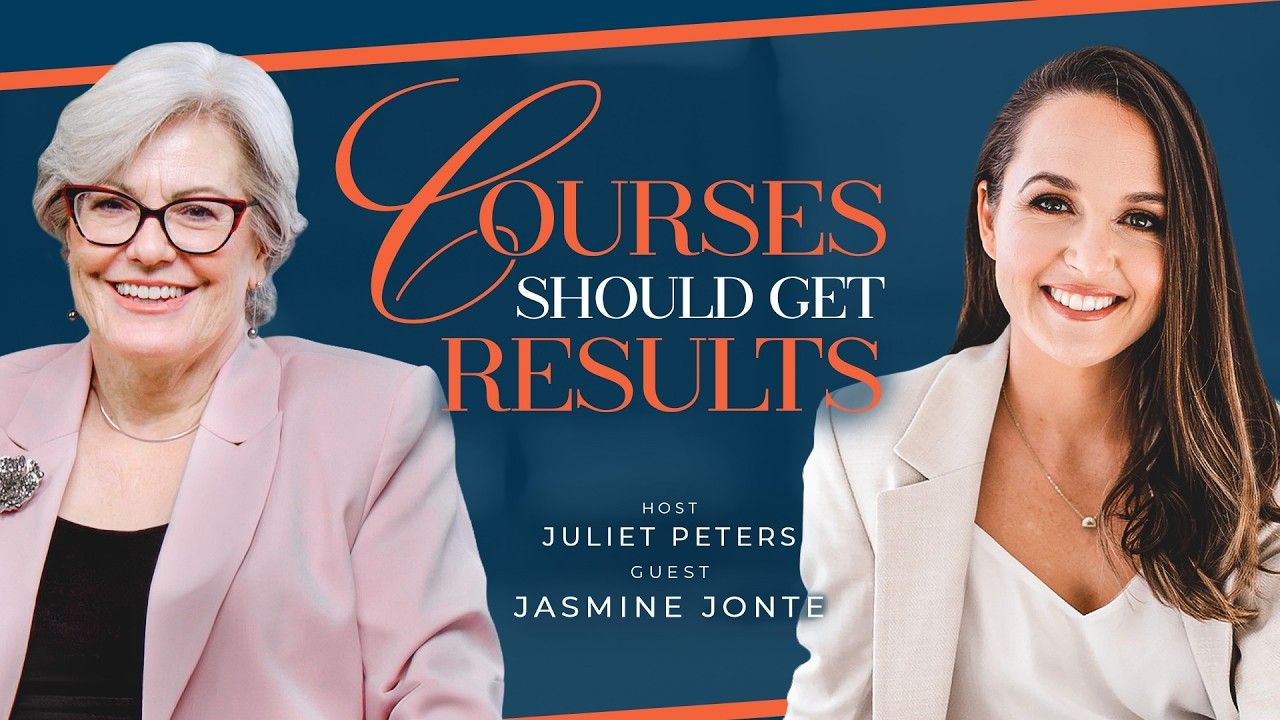
Some founder stories start with a lightbulb moment. Jasmine Jonte's started with a $7,500 lightbulb — and it was a bad one. 💡
On the Her Table, Her Rules podcast with Juliet Peters, Jasmine — founder of Cre8tion — walked through her path from a first-grade classroom in one of the lowest-performing schools in the country to running an agency that ghostwrites entire courses for experts. Along the way, she got refreshingly honest about what separates a course that actually transforms students from one that quietly collects dust.
Here's the conversation, broken down. ✅
Q: You started as a teacher, not a course creator. How did that background shape your business?
A: Jasmine joined Teach for America straight out of college and was placed in Detroit — later learning (after the fact, which she's grateful for) that it was one of the lowest-performing schools in the country. Teaching kindergarteners, some of whom didn't know the alphabet and others who could already read, forced her to get skilled fast at one specific thing: making learning simple and fun for a wide range of ability levels at once.
That skill — meeting people exactly where they are — is the throughline in everything her agency does now, even though her "students" today are grown adults building online programs.
Q: What actually pushed you from teaching into entrepreneurship?
A: Money, mostly, if we're being honest — teachers don't make much, and Jasmine was earning $38,000 a year while side-hustling on the side. She still remembers landing her first $40,000 client and realizing she'd made in a single sale what used to take her an entire year to earn.
But the leap wasn't instant or clean. It took four years of niche-hopping — trying different things, learning what business and marketing actually meant — before she landed on done-for-you course creation specifically. Her honest advice for anyone in that murky middle phase: personal development kept her from quitting. She leaned hard on personal growth work and the stories of people who came from nothing and didn't give up, especially since she didn't have a financial cushion to fall back on the way some entrepreneurs do.
Q: What actually led you to specialize in course creation?
A: A bad $7,500 course, to be specific. 😤
Jasmine bought a marketing program that turned out to be, in her words, obviously slapped together — an expert recording himself on a walk, with a virtual assistant dubbing slides on top afterward. It worked financially for the person selling it (allegedly generating millions), but it left buyers like Jasmine feeling duped.
That experience surfaced a pattern she's built her entire business around: many experts have the exact opposite skill set from teachers. They can market and sell, and they genuinely know their subject — but they don't know how to package that knowledge into an experience someone else can actually learn from and complete.
🎯 The insight: Expertise and teaching ability are two different skills. Being great at the first doesn't guarantee you're good at the second — and that gap is exactly where bad courses come from.
Q: How do you make sure a course actually works for the people buying it?
A: It starts with knowing your ideal client specifically — not broadly. Jasmine's team thinks about programs in two lanes:
- Curriculum — the actual training content
- Support structures — everything around the content that helps someone integrate it
Both of those need to be filtered through the lens of who's actually taking the course. A busy mom in her 30s doesn't want (or have time for) a 15-hour program — she wants something closer to a podcast episode she can listen to in the carpool line. Meanwhile, Jasmine has built programs for clients in their 70s who preferred content delivered on DVD. Same underlying content, wildly different delivery.
✅ The takeaway: There's no universal "right way" to build a course. There's only the right way for your specific audience.
Q: How do you know if you're actually ready to build a course?
A: Jasmine's bar here is firm: you need to have worked with at least 10 people one-on-one and gotten them the result — through group work, not self-paced content — before you productize anything.
Why so specific? Because most people assume that since they personally went through a transformation, they can just repackage their own experience into a course. But one data point (you) can't reliably predict what a whole audience of different people will need. You need the pattern recognition that only comes from working with real humans first.
Q: How do you design for different learning styles without the course spiraling out of control?
A: Jasmine points to the three most common learning styles — visual, auditory, and kinesthetic — and explains why video-based programs tend to naturally cover the first two: visual learners get the visual, auditory learners can simply listen. For kinesthetic learners, the fix is usually a workbook or something tangible they can actually manipulate, take notes in, or work through by hand — not just watch or listen to.
Beyond content format, she flagged something a lot of creators miss: support structures are part of learning style design too. Group coaching, community, and peer interaction — even asynchronous — help students socialize what they're learning, which deepens and speeds up the transformation.
💡 Simple benchmark: If your program hits visual, auditory, and kinesthetic in some form, you're already ahead of most courses on the market.
Q: What's the biggest mistake you see in course content itself?
A: Founders forgetting to make it actionable — and, more bluntly, over-indexing on their own story once someone has already bought.
Jasmine doesn't mince words here: "Nobody cares about your story" once someone's already a paying student. A 15-minute origin story or an extended bio might matter during the sales process, when you're building trust and credibility — but after purchase, the student already bought in. What they need now is content built for their transformation, not another retelling of yours.
That doesn't mean storytelling has no place inside a program — it does. It just has to serve a teaching point for the student, not reinforce the expert's authority. Stories stick because our brains are wired to remember them — so use that mechanism in service of the lesson, not the founder's résumé.
Q: Who typically comes to you ready to build a leveraged offer?
A: Usually experts who are "renting their brain by the hour" — fully booked, wanting more impact, but out of hours to sell. The fix is decoupling time from money through a leveraged offer, and for first-time course creators, Jasmine's team often starts with a high-ticket group coaching program: one group call on the calendar instead of a stack of 1:1 sessions, backed by strong curriculum.
Interestingly, this move doesn't just add a new offer — it improves the existing 1:1 business too, streamlining how clients move through the pipeline. It tends to be the right fit for experts whose skill set is highly specialized and valuable enough that DIYing the tech side (instructional design, video editing, platform builds) simply doesn't make financial sense.
Q: What does "excellent" course content actually look like, in practice?
A: At a high level: total alignment between the curriculum, the support structure, and what the ideal client actually needs — no more, no less.
One concrete example Jasmine shared: a longtime tarot education client (15 years in business, one of the original players in that space) recently added an AI agent trained specifically to help students understand tarot card meanings. It's now ranked among the top-performing AI agents on its platform — not because AI is trendy, but because it solved a precise, specific need for that exact audience.
Q: Where do you see course creation heading, especially with AI everywhere now?
A: Jasmine expects a continued move away from purely self-paced programs. The barrier to entry for "content" has dropped so low (hello, AI-generated course outlines 🙃) that raw information alone is losing its differentiating power — and Jasmine's blunt assessment is that most AI-only content isn't good yet.
Her prediction: hybrid experiences — some mix of live support, asynchronous content, and community — will become the standard, and AI integration will shift from "nice differentiator" to simply expected. She's already seeing this show up in creative ways, including AI accountability coaches that call students at the start of a program, confirm their first homework assignment, and follow up on a set cadence — fully automated, but built to keep people moving.
⚠️ Worth noting: not every audience wants this. Whether AI support feels helpful or "creepy" depends entirely on the ideal client — which loops right back to knowing your audience before you build anything.
Q: How should someone decide between community formats — like calls, in-person events, or discussion threads?
A: Again: ask your people, don't assume. Jasmine is refreshingly candid that she personally dislikes discussion threads — if her own communities had asked her directly what she'd find valuable, she'd have said "please kill the discussion thread, it's just another to-do."
Her recommendation for anyone unsure which support format fits their audience: talk to real humans who'd be a good fit for the offer. Get clear on the promise, get clear on what's included, and ask directly about anything uncertain. AI research can help, she notes, but nothing replaces old-fashioned human-to-human conversation for figuring out what your specific audience actually wants.
The Bottom Line
Being an expert doesn't automatically make you a great teacher — that's a separate, learnable skill. The courses that actually deliver results are built around a clearly defined ideal client, respect different learning styles, keep the spotlight on the student (not the founder's story), and layer in the right kind of support — human, AI, or both.
Wondering if your expertise is ready to become a course people actually finish? 🚀 Head to cre8tion.co or check out Jasmine's weekly YouTube channel for more real talk on building programs that work.
Loved this conversation? Subscribe for more episodes on entrepreneurship, course creation, and building a business on your own terms.
Join Thousands of Course Creators + Get FREE Weekly Tips in your Inbox
The folks on my list get the goods, by which I mean... insider scoop on the biz, personal life updates, and first chances to join me in new opps. You're in good company. No spam, ever.
We hate SPAM. We will never sell your information, for any reason.
