
Fully Booked in 1:1 Work? The Decision That Determines Your Freedom
Feb 04, 2026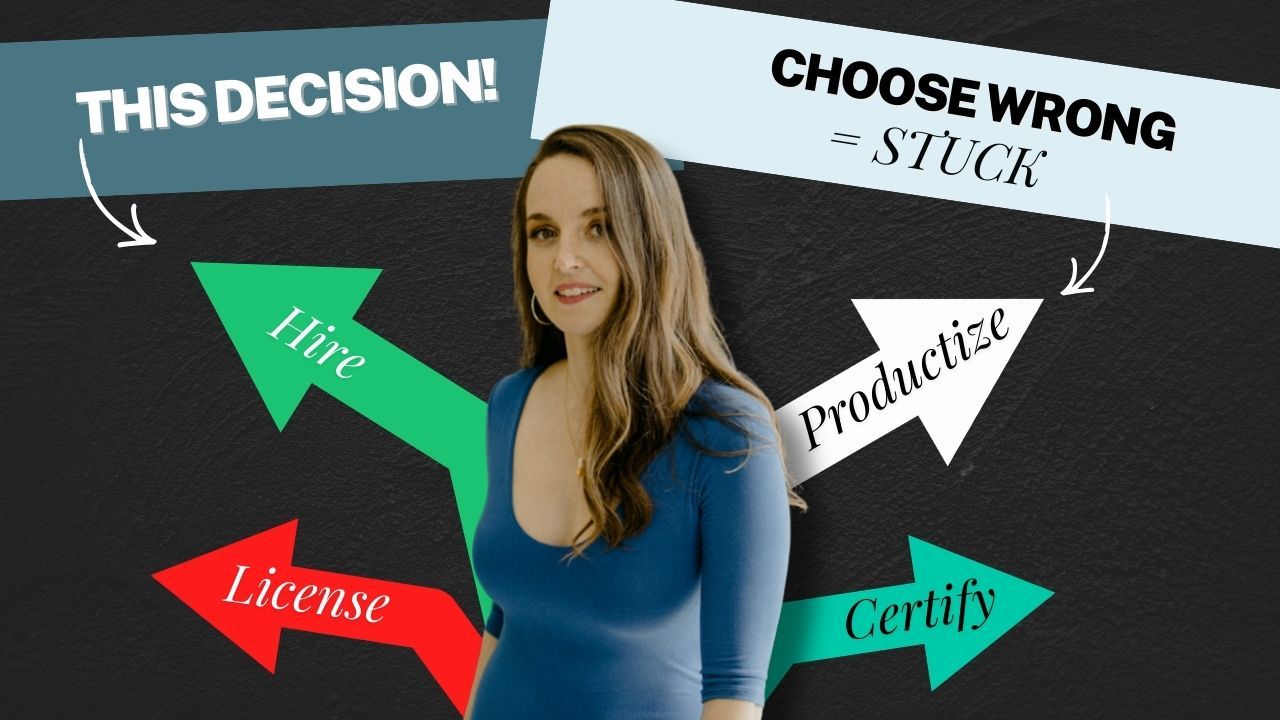
Fully Booked Is an Achievement—and a Constraint
If you’re fully booked in one-on-one work (or quickly heading there), this post is for you.
Being fully booked is usually the moment people think they’ve won. It’s the milestone most experts work toward for years. Demand is steady. Income is solid. From the outside, things look great.
But internally? Something feels off.
Not because you’re failing—but because you’re maxed out. 🎯
This is the moment no one prepares you for: when demand stops being the problem and capacity becomes the bottleneck.
And if you want more freedom—more time, more leverage, more optionality—the next move matters more than hiring randomly, launching a course impulsively, or copying someone else’s business model.
The Choice Point Most Experts Don’t See Coming
When you’re at capacity, you hit what I call the choice point.
At this point, something has to change—whether you make that decision intentionally or not.
The biggest mistake people make here is asking:
“How do I scale?”
That question usually leads to reactive decisions and shiny-model syndrome.
The better question is:
What model is aligned with the life I want, the business I want, and the skills I actually want to use every day?
There isn’t one right answer. There are several viable paths forward—but they work for different people.
Let’s walk through the four most common (and most misunderstood) options.
Path #1: Hire to Delegate Delivery)The first path is hiring to delegate delivery.
You keep your service. You usually keep similar pricing. But you’re no longer the sole point of delivery.
This might look like:
- Passing new clients to trained team members
- Transitioning some existing clients off your plate
- Staying involved at a higher, more strategic level
This model works best if:
- Your service is repeatable or retained
- You genuinely enjoy training and managing people
- You’re building toward enterprise value or an eventual exit
Here’s the reality check: freedom in this model comes from delegation, not disappearance.
If you don’t want to lead a team, manage performance, or build systems others can follow, this path will drain you—even if it makes more money.
✅ This path rewards leadership and operational strength.
Path #2: Create a Leveraged Offer Around Your Existing Service
The second path is leveraging what you already do—but not in a 1:1 capacity.
You’re not teaching people how to build your business. You’re helping the same type of client get the same outcome with less direct access to you.
Examples:
- A social media manager creates a group coaching program so clients can manage their own accounts
- A PR agency teaches clients how to run their own PR using proven systems
This path often shows up as:
- Courses
- Group programs
- Memberships
- Done-with-you offers
The upside is leverage. 🚀
You move from 1:1 to 1:many, freeing up significant time on your calendar.
The requirement is structure.
This only works when you have:
- Clear curriculum
- Strong boundaries around access
- Support systems that don’t rely entirely on you
There’s also a marketing shift here. Instead of low-volume, high-ticket sales, you’re often moving toward higher volume and potentially lower price points.
If you don’t want to learn marketing—or hire for it—this path may not deliver the freedom you’re looking for.
Path #3: Certification — Teaching Others to Do What You Do
Certification is not just education.
It’s authorization.
You’re giving someone a badge—a stamp of approval—that says:
- You have the skill
- You’ve been trained to a standard
- You can now trade this skill for income
That might mean promotions, clients, or delivering services under your methodology.
Here’s the risk most people underestimate: when you certify someone, you extend your brand through them.
If a certified practitioner delivers a poor experience, that experience can reflect back on you.
Which means certification requires:
- Clear standards
- Assessments and quality checks
- Rules around how people market themselves under your name
One major upside? Certification often becomes a hiring pipeline.
Certified practitioners frequently step into:
- Support roles
- Delivery roles
- Facilitation inside done-with-you programs
But certification also requires operating at a higher level—evaluating, approving, and maintaining standards over time.
Without infrastructure, this path can quietly break your business economics.
Path #4: Licensing Your Expertise to Organizations
Licensing is built on having a strong body of work—curriculum, training content, facilitation guides, or structured experiences.
Licensing agreements might include:
- Short-term programs
- Multi-year contracts
- Company-wide training initiatives
What people don’t realize is that licensing introduces two audiences:
- The buyer (often leadership)
- The participants (who may not have opted in)
This creates a buy-in challenge you rarely see in B2C offers.
Licensing also tends to sneak time back onto your calendar through:
- Data review
- Results tracking
- Relationship management
- Requests for live trainings or speaking
Because of this, licensing is rarely hands-off. It often becomes hybrid—supported by facilitators, certified practitioners, or hired delivery partners.
If pursued too early, long sales cycles alone can break the model.
The Through Line That Makes Any Path Work
No matter which path you choose, two things are always required:
1. Curriculum
Even agencies run on internal curriculum if they want consistency and quality.
2. Experience
How people move through the work. How they’re supported without your constant presence.
This is what productizing your expertise actually means.
There’s risk in choosing the wrong model—but there’s far more risk in choosing a model without infrastructure. 💡
What to Do Next
If this post made you rethink your next move, I invite you to:
🎥 Watch the full video embedded above for deeper context.
📩 Join my free masterclass on how to productize what you already know—no pitch, just clarity here: www.cre8tion.co/extract-your-course.
And if you’re building toward freedom instead of burnout, make sure to subscribe for more insights on creating scalable, aligned offers.
FAQ
1. Is being fully booked a bad thing?
No—being fully booked is proof of demand. The challenge comes when capacity becomes the constraint and no clear next model is in place.
2. Which scale path is best?
The best path is the one aligned with your desired lifestyle, business goals, and strengths—not what’s trending online.
3. Do I need a course to scale?
Not necessarily. Courses are one option, but hiring, certification, and licensing can all create leverage when designed correctly.
4. When should I consider certification?
Only once you have a proven method, strong brand standards, and the infrastructure to support quality control.
5. What’s the biggest mistake experts make at the choice point?
Choosing a model without considering the long-term support, systems, and energy required to sustain it.
Join Thousands of Course Creators + Get FREE Weekly Tips in your Inbox
The folks on my list get the goods, by which I mean... insider scoop on the biz, personal life updates, and first chances to join me in new opps. You're in good company. No spam, ever.
We hate SPAM. We will never sell your information, for any reason.
