
Getting More Wins: How to Give Your Course Students Better Results
Feb 19, 2026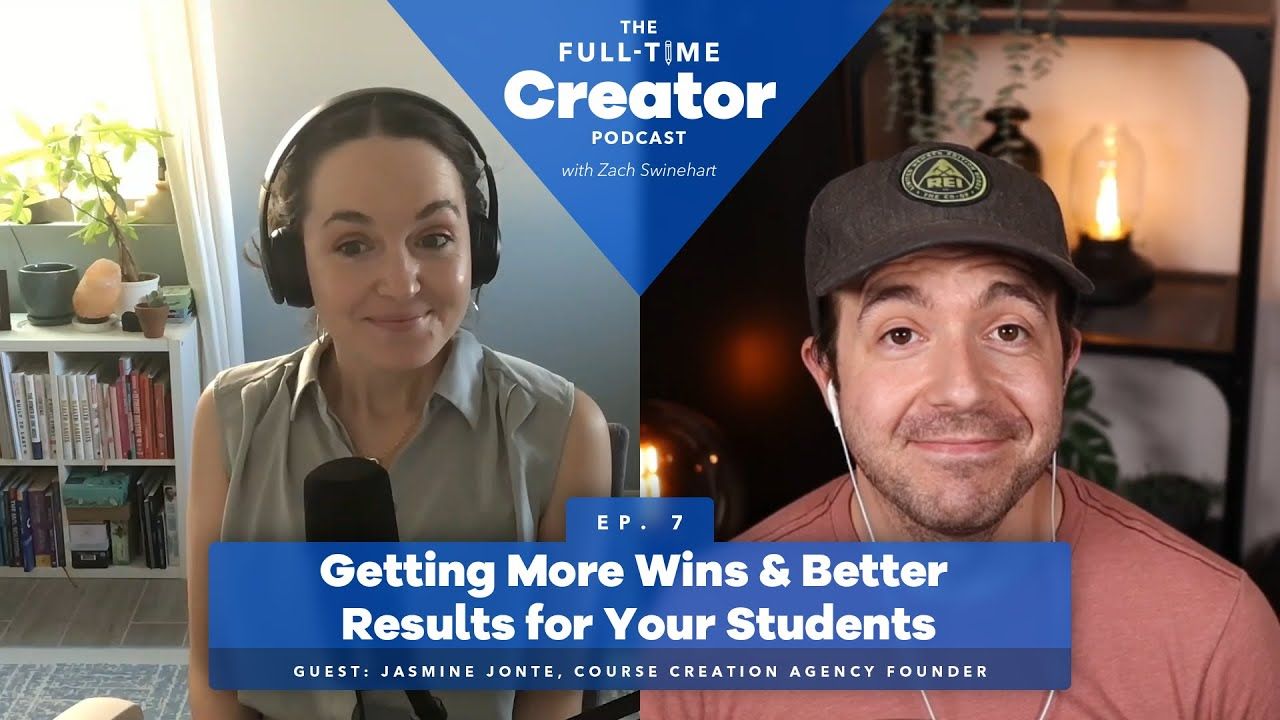
Ever build out a course lesson, then think, "but what about that one time a client asked me something totally different — should I add a module for that too?"
If you've ever felt the pull to cram in every possible edge case "just in case," you're not alone — and according to Jasmine Jonte, founder of Cre8tion, that instinct is exactly what tanks student completion rates. On the Full Time Creator Podcast with Zach Swinehart, Jasmine unpacked her framework for what she calls the "Goldilocks zone" of course content — not too much, not too little, just enough to actually get your students results.
Let's dig into the Q&A. 🎯
Q: How do you know how much content is "enough" without overwhelming students?
A: Jasmine's litmus test is refreshingly simple: imagine 10 of your ideal past clients standing in front of you. Would this piece of content help at least 8 of them?
Here's the trap experienced experts fall into — the more clients you've worked with, the more "aha" moments and one-off stories you've collected. It's tempting to think every single one of those gems deserves its own lesson. But most of them only mattered for that one client, that one time.
The real question isn't "what's the most interesting thing I've ever said?" It's: what actually moved the needle for the majority of my students?
💡 Quick gut-check: If a student watched your course and only 20% of it applied to them, would they keep watching? Probably not. Aim for content that resonates with roughly 80% of your audience — and handle the rest a different way (more on that below).
Q: But what about the 20% who don't fit the main path — won't they get stuck?
A: This is where Jasmine's structure gets smart. Instead of building a "bajillion lessons" to catch every edge case (content that, realistically, will never get watched by most people), she recommends two things:
1. Build support around the content, not just into it
Group coaching calls, Facebook communities, Q&A sessions — these exist for a reason. But simply having them isn't enough. Jasmine's tip: train your students on how and when to use your support systems. Don't just say "there's a Facebook group, use it." Tell them exactly when to activate it, and what to bring.
2. Create a bonus content "side door"
If you notice 15–20% of students consistently get stuck on one specific thing, don't rework your main training — build a short, secondary bonus video and point to it directly: "If you're struggling with this, check out the bonus training for another angle." You're solving a real problem without bloating the core path for everyone else.
✅ The takeaway: Support content and core content are two different jobs. Keep your main path lean for the 80%, and quietly build side doors for the rest.
Q: Should long, complex courses always include some kind of community or support?
A: Jasmine doesn't hedge on this one: yes, always.
If you're building a program without any support layer because it doesn't fit your lifestyle, her advice is direct — don't build that program. You wouldn't actually be serving your students.
That said, "support" doesn't have to mean you personally, on every call, forever. Jasmine shared two workarounds that still protect the founder's time:
- Train a coaching team on your specific methodology so support scales without you being the bottleneck.
- Use asynchronous feedback loops — students submit a workbook or exercise in the portal, and you (or your team) send back a short Loom video with direct feedback. No calendar coordination, no time zone chaos, still deeply personal.
Q: How do you decide where in the course to put the "hard" or scary steps?
A: This depends entirely on how sensitive the transformation feels to your specific audience — and Jasmine's answer here is nuanced, not one-size-fits-all.
For emotionally loaded topics (she used a dating program for high-achieving women as an example), it makes sense to start with something that already feels safe and familiar — like updating a dating profile — before asking someone to do something much more vulnerable, like a hard conversation on a first date.
But in other cases — especially in the business space, where people already know something's a problem and are ready to act — a bold, early action can actually build momentum. Jasmine pointed to a multifamily real estate investing program where the hardest skill (underwriting deals, spreadsheets and all) is intentionally placed at the very beginning. Why? Because once a student masters that one intimidating skill, their confidence in talking to investors and evaluating deals skyrockets — and it removes the "fear of what you don't know you don't know" early, instead of letting it linger.
🎯 The strategic question to ask yourself: Is this hard step something my audience is emotionally ready for on day one, or does it need a warm-up first?
Q: How do you handle teaching something now while reassuring students you'll cover the rest later?
A: Jasmine calls this creating (and closing) open loops — and she shared a simple verbal template you can borrow almost word-for-word:
"Once we're done here, you're going to take these steps and apply them right away. You might start wondering, 'what about X?' Don't worry — we're going to get to that in Module 3. For now, the only thing you need to do is take action on this one step."
This keeps students moving forward without feeling like they're missing something critical — because you've told them explicitly that the gap will be filled, just not yet.
How do you know what open loops to anticipate? Jasmine's team leans on real data: comments under video lessons, common questions on coaching calls, and patterns course creators have noticed over time from working 1:1 before going to group format. If you're revamping an existing program, mine that historical data. If you're newer, trust the patterns you've already seen with past clients.
Q: What about "foundational" topics — like mindset or business basics — that feel important but risk slowing everyone down?
A: This is where Jasmine dropped one of the most useful (and memorable) frameworks of the conversation: momentum beats mastery.
Her advice isn't to skip mindset or fundamentals — it's to stop treating them as their own dedicated module. As she put it: "Don't name your module mindset. Don't even tell them you're teaching them mindset when you're teaching them mindset." Instead, bake a small, relevant mindset principle into every lesson, tied directly to the specific action step at hand.
She compared it to sneaking black beans into brownies — you're still getting the nutrition, but nobody feels like they're eating something they don't want. 🍫
For dedicated business fundamentals that only some students need (like understanding profit margins before running an agency), Jasmine's team includes one lesson early on called "How to Get the Most Out of This Program" — where the biggest mindset shifts and orientation tips live — and then folds in more specific fundamentals within the relevant module later, rather than front-loading everything before students get a win.
The core principle: the goal isn't to prevent every possible failure in advance. It's to get students a real win as fast as possible, so they're being pulled through your course instead of pushing themselves through it.
Q: If someone wants to improve an existing course, where should they start?
A: Jasmine's team runs course audits using a good, better, best framework — and the "good" tier might surprise you, because it usually has nothing to do with re-filming content.
- Good: UX-level fixes inside the portal — adding workbooks or handouts for visual learners, or turning written material into audio (even via AI) for a private podcast feed so people can consume on the go.
- Better: Using real student data to identify exactly where people get stuck, then recutting those specific videos to be clearer.
- Best: A full rebuild — usually reserved for programs that haven't been touched in 5–10 years (yes, some clients are still working with content filmed in the actual '90s 📼).
The reassuring news: most programs don't need to go down to the studs. The fix is often simpler than creators assume.
Q: Any final wisdom for course creators feeling stuck?
A: Jasmine's closing thought cuts right to it: being a great coach, consultant, or entrepreneur doesn't automatically make you a great teacher — and that's okay. Teaching is its own skill, just like copywriting or sales. Creators who care deeply about their students but struggle to structure their content aren't failing — they just haven't trained in this particular skill yet.
The Bottom Line
Your students don't need every possible answer up front — they need momentum. Aim your core content at the 80%, build smart side doors for the rest, bake mindset into the action steps instead of isolating it, and use real support systems (live or async) to catch people when they get stuck.
Want the exact framework Jasmine's team uses to make courses genuinely binge-worthy? 🚀 Grab her free guide, How to Make Your Program as Binge-Worthy as Netflix, or head to cre8tion.co to book a course audit and see exactly where your program's good-better-best opportunities are hiding.
Enjoyed this breakdown? Subscribe to the podcast for more real conversations on building courses that actually work.
Join Thousands of Course Creators + Get FREE Weekly Tips in your Inbox
The folks on my list get the goods, by which I mean... insider scoop on the biz, personal life updates, and first chances to join me in new opps. You're in good company. No spam, ever.
We hate SPAM. We will never sell your information, for any reason.
