
Jasmine Jonte on Transforming Expertise into Engaging Courses
Feb 16, 2026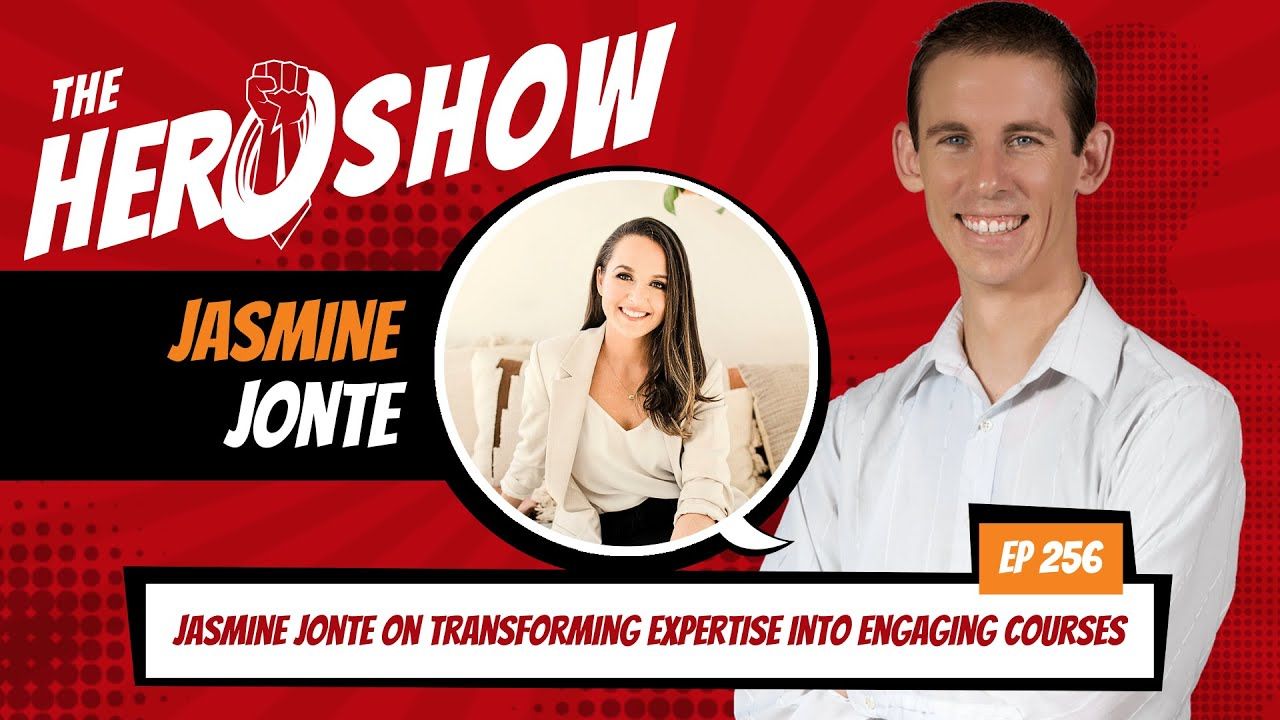
What if the difference between a course that flops and one that changes your business isn't the quality of your expertise — it's whether anyone taught you how to teach it? 🎯
Jasmine Jonte, founder of Cre8tion, joined Richard Matthews on The Hero Show for a wide-ranging conversation that opens with one of the more striking before-and-after stories you'll come across in this space. Let's get into it.
Q: Can you share an example of what instructional design actually does for a course's real numbers?
A: Richard shared this one from his own consulting past, and Jasmine confirmed she sees the pattern constantly. A real estate investor and educator — doing $200K+ a month in his own investment business — built his first educational course entirely himself. It was genuinely comprehensive: hiring, processing, every aspect of running a real estate business, all included.
The problem? It had a 10% completion rate, and only 3% of those who completed it ever closed their first deal. The information was good. The structure was not — because he was a real estate expert, not an instructional designer.
After a full instructional design overhaul — restructuring what was in the course, what order it came in, and how it was chunked — the results transformed: completion rate jumped to 86%, and roughly 80% of those who completed it closed their first real estate transaction. His education business went from about $1,200 a month to over $250,000 a year — in about six months.
💡 What actually changed? Not the underlying knowledge — the structure. The course originally tried to teach someone how to run an entire real estate business at once. The fix was breaking that enormous transformation into a single, believable first milestone: "how to close your first property in 60 days." Everything else became a separate program addressing the next problem, once students had already succeeded at the first one.
Q: Why is it so common for true experts to struggle with structuring their own content?
A: Jasmine's explanation is one worth sitting with: the more expert you are, the harder it often is to build a good program, because you have so much knowledge and experience to sort through to figure out what actually belongs.
She compares an expert's knowledge to a filing cabinet with 100 files. In one-on-one work, pulling the exact file a specific person needs in the moment is easy — you can see their reaction and adjust. But in a group program, without that real-time feedback, you have to correctly guess which roughly 10 of those 100 files apply to most people, and in what order — without the built-in course-correction that comes from watching someone's face in real time.
There's a second layer to this too: experts are often teaching from an outdated starting point. If someone became an expert in the '90s and is now teaching beginners in the present day, some of what they originally needed to learn is no longer relevant, and some of what's relevant now didn't exist when they started. The right question isn't "how did I learn this?" — it's "if I were starting today, what would I actually need?"
Q: What does "persuasive teaching" actually mean?
A: This is a phrase Jasmine embraced enthusiastically in the conversation, and it captures something a lot of creators miss: marketing doesn't stop once someone buys.
Most creators pour enormous energy into persuading someone to say yes to a purchase — and then completely drop that persuasive mindset the moment the sale closes. Jasmine's reframe: keep the marketing hat on, but pivot the angle. Instead of persuading someone to buy, you're now persuading them to finish — using the same underlying principles (in her team's case, elements of neurolinguistic programming) to keep students engaged, taking action, and moving through the content to an actual result.
✅ The core distinction: an expert without teaching skills asks "what can I teach?" A skilled instructional designer asks "what are they going to actually do with what I'm teaching?" — and builds backward from that action.
Q: You called this a "persuasive learning" problem earlier — what does that actually feel like from a student's side?
A: Richard put this well in the conversation: think about a course where you got to the end and know you learned something, but couldn't actually do anything with it. That gap — content that's technically good but doesn't produce action — is almost always an instructional design problem, not a content quality problem.
Q: What are the biggest obstacles you regularly have to help clients push through?
A: Two stood out clearly in this conversation:
Perfectionism
Jasmine sees this constantly — people who've had a fully fleshed-out course outline sitting untouched for three or four years because it's "not quite ready." Her honest pushback: if you're waiting for perfect, you're never going to ship — and there's nothing to improve on a course that doesn't exist yet.
"Marketer ick"
Many experts want the business results — income, impact, reach — but resist actually marketing because they associate it with the "bro marketer" archetype they've seen online. Jasmine's reframe: to make a digital product genuinely work and scale, you have to become a marketer in some form — the real work is figuring out how to do that ethically, using marketing as a force for good rather than something that feels icky. A single bad experience buying a course (or working with a marketer) shouldn't color every future decision — the same way one bad date doesn't mean giving up on dating entirely.
Q: What's your honest philosophy on business growth — fast or slow?
A: Deliberately, intentionally slow, at least early on. Jasmine describes her own growth approach as "slow as smooth, smooth as fast" — she's grown her agency from working with one or two clients at a time to consistently managing 6-10 clients across various stages, and she's chosen to prioritize team stability and sustainable systems over aggressive, high-risk scaling.
Her broader philosophy: "once you surrender to patience, everything speeds up." She and Richard swapped notes on a shared observation — most entrepreneurs vastly overestimate what they can accomplish in a single year, and vastly underestimate what's possible over a decade. The early "I'll make a million dollars this year" expectation rarely survives contact with reality — and the frustration that follows often has less to do with ability and more to do with timeline miscalibration.
Q: How do you think about your own strengths as a founder?
A: Jasmine describes an ability to absorb large amounts of information without becoming overwhelmed by it — she can take a messy, unstructured course (or a tangled business strategy question) and simplify it into something clear and actionable. Richard pointed out this is really a form of systems thinking — the ability to see the underlying framework behind information, rather than getting lost processing each individual piece.
The flip side, by her own admission: a tendency toward cautious, incremental action (moving the ball forward in small, deliberate steps) rather than big, high-risk swings — something she's aware of but hasn't had much occasion, or need, to fully test against.
The Bottom Line
The gap between a course that gets ignored and one that transforms a business is rarely the quality of the expertise behind it — it's whether that expertise has been structured for someone who doesn't already have the knowledge in their head. Break big transformations into believable first milestones, keep your "marketing hat" on all the way through completion (not just the sale), and remember that the more expert you are, the more deliberately you need to fight the instinct to include everything you know.
Curious what instructional design could do for your own course's completion rate? 🚀 Head to cre8tion.co to talk through what your program might be missing.
Enjoyed this conversation? Subscribe to The Hero Show for more stories from the entrepreneurs building things that matter.
Join Thousands of Course Creators + Get FREE Weekly Tips in your Inbox
The folks on my list get the goods, by which I mean... insider scoop on the biz, personal life updates, and first chances to join me in new opps. You're in good company. No spam, ever.
We hate SPAM. We will never sell your information, for any reason.
