How Do I Name My Method? Turning What You Do 1:1 Into a Framework You Can Sell
Oct 20, 2026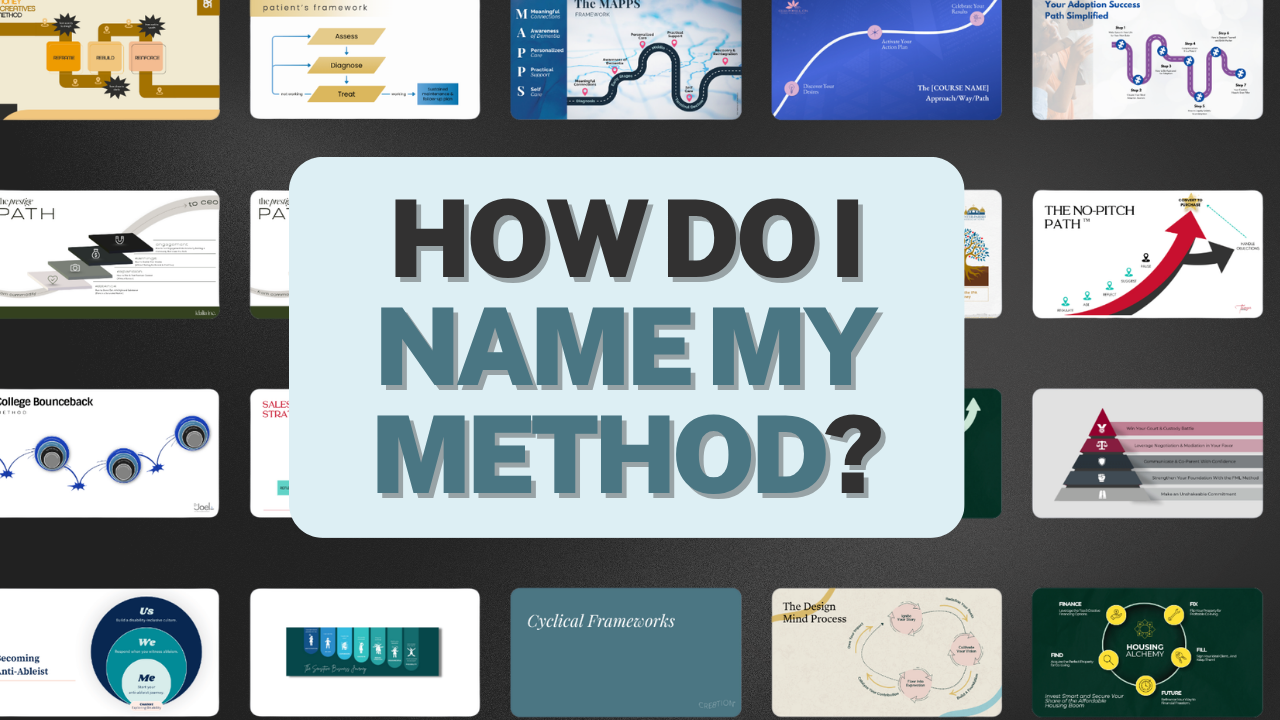
Key Takeaways
- You don't have a content problem. You have an unnamed method. If you can predict what a new client will struggle with in month two, the method already exists; it just lives in your head and gets re-delivered by hand.
- A method has two ends and a road between them: a current reality, a desired outcome, and three to seven milestones in between. Name those and you have named the method.
- Milestones follow one naming convention (verb plus outcome, compound noun, or single verb). Mixing conventions is how clever acronyms turn into unclear methods.
- Pick the shape your method actually moves in: linear, cumulative, cycle, parts of a whole, or a combination. Don't force a cycle into a straight line because it looks cleaner on a slide.
- The name comes last, and it should describe the transformation, not decorate it.
- You can do the whole thing in about 20 minutes with a pen, then pressure-test it with CRE8TION's free Signature Method Generator.
Your method is the thing you've been doing on repeat and charging by the hour for. Naming it is not an act of invention. It's an act of transcription: writing down the sequence you already run with every client, in the order you run it, with a name on each step. Here is how CRE8TION does it with experts in the Architect phase of a build, and how to do a first pass yourself this week.
Why do I feel like I don't have a method?
Because you've never had to say it out loud in order. You deliver it live, adjusting as you go, which hides the structure even from you.
Jasmine Jonte, CRE8TION's founder, hears this from booked-out experts constantly, and her answer is the same every time: you can already predict what a new client will struggle with in month two. You know where they'll get stuck and what you'll say when they do. That prediction is the method. After 170+ programs built, the pattern holds: the experts who think they're missing a framework are usually missing a piece of paper.
The reframe she gives clients who feel disorganized about it: "That's totally normal. And if you didn't have that problem, that would just mean you weren't a true expert."
Where do I start?
With the two ends, before anything in the middle. Every framework has a current reality and a desired outcome, and CRE8TION names those first, because the milestones only make sense once you know what they're bridging.
- Current reality: who the client is when they find you.
- Desired outcome: who they are when they're done.
CRE8TION's own version: experts trading time for money → experts with a leveraged offer. A client of ours who's an operations consultant: new hires productive in 90 days → new hires productive in 30 days.
Then write one sentence that holds both ends. The prompt CRE8TION uses in working sessions is deliberately dramatic, because it forces specificity better than "from X to Y": "Your mission in this program, should you choose to accept it, is to ____." If you can't say it in one breath, it's too long. The CRE8TION team credits this sentence starter to Marisa Murgatroyd, as she's who they learned of it's application in this setting.
How many milestones should my method have?
Three to seven. No more. Fewer than three and it isn't a process. More than seven and you've listed tasks, not milestones.
Milestones are the steps between current reality and desired outcome. The test for each one: could a client skip it and still get the result? If yes, it isn't a milestone, it's a task inside one.
Four examples, all real:
- CRE8TION, five milestones: Evaluate → Architect → Build → Video → Upload.
- The operations consultant, four: Audit → Scorecard → Build → Rollout.
- Jonny Stevens' composite dentistry program, three: Strategy → Workflow → Implementation.
- Tanya Waymire's No-Pitch Path, three: Reflect → Refine → Set New Records.
Write yours as a list, then do the skip test on each one.
How do I name the milestones?
Pick one convention and stay in it. There are three that work:
- Verb plus outcome: Audit the current onboarding. Build the 30-day scorecard.
- Compound noun: Onboarding Audit. Readiness Scorecard.
- Single verb: Audit. Score. Build.
What not to do is mix them to make an acronym work. One program CRE8TION reviewed used "You Had Me at WOOF": Welcome Home, Obedience Train, Other Dogs Activity, Fun & Playtime. Four different structures. The acronym is cute. The method is unclear, and students feel that even if they can't say why.
Verb plus outcome is the safest default, because it tells the student what happens and what they'll have afterward.
What shape is my method?
Whichever shape it actually moves in. This is the step most experts skip, and it's why so many frameworks look like a numbered list when the work isn't linear.
- Linear: each step must happen in order. Step three is impossible without step two.
- Cumulative: each step stacks on the last and stays active. Nothing gets left behind.
- Cycle: the process repeats. Clearing the last step returns you to the first at a higher level.
- Parts of a whole: all components are required, but order doesn't matter.
- Combination: a linear spine with a cycle inside one phase, or similar.
Two examples of getting the shape right. Jodi Finer walked into Architect Day assuming Design Mind was linear, a start-to-finish journey. Working through the milestones, it turned out to be a cycle students return to as their creative life evolves, and that one reframe changed everything about how the program was built (the Design Mind case study). Amy Reczek's sales training went the other way: parts of a whole, built as modular pillars that can be bought one at a time or as a full suite (the Amy Reczek case study).
Don't teach yourself all five. Look at your milestones, name the shape, move on. The shape matters later because it determines how the method gets drawn, and a drawn framework is a visual anchor for a predictable, repeatable process. That's the asset you'll put on a sales page and at the top of module one.
What should I actually call it?
Something that names the transformation, and only after the milestones exist. Naming first is how experts end up with a brand name in search of a method.
Three tests for the name:
- Does it say, or at least point at, the outcome?
- Would a client repeat it to a friend without explaining it?
- Does it survive being said out loud on a sales call?
If you're stuck, "The [Outcome] Method" or "The [Number]-Step [Outcome] Framework" is better than something clever. Course Flow to Cash Flow is a method name that tells you what it does. That's the bar.
What do I do with it once it's named?
Sell from it before you build anything. A named method with three to seven milestones is enough to put on a page, describe on a call, and price. The lessons, slides and portal come after the first buyers.
Eric Reiners did exactly that. His program was built on his signature framework, and he was closing clients with the framework before the program itself was finished: "I just sold a client, actually, right before this call, using the framework. The framework makes it look so much more professional. The client said, 'I love this structure.' It gives me confidence when I sell."
It's also where CRE8TION starts every build. The Architect phase is a two-week working session that produces the visual framework, the full outline with lessons and action steps, and the templates, with you in the room. If you arrive with a named method, that phase gets shorter. If you arrive with a pile of notes, it's where the method gets named.
The fastest way to pressure-test what you wrote: run your mission line and milestones through the free Signature Method Generator. It tightens the milestone language, checks your naming convention, and gives you three versions of the name. If you'd rather do it with someone across the table, book a discovery call. This is a fit conversation to determine if the CRE8TION team can help, and if not, point you in the right direction.
Common Questions
What's the difference between a framework and a course outline?
The framework is the method: the milestones a client clears, in order, to get from current reality to desired outcome. The outline is how you teach it: modules, lessons and action steps hung off each milestone. Name the framework first; every lesson then lives under a milestone, and nothing floats.
Can I name my method if I've only worked with clients one-on-one?
Yes, and that's the best time to do it. If you've taken ten or more clients through the same work, you've tested the method on paying clients ten times. Write down what you said every single time, in the order you said it. That's the first draft.
Do I need an acronym?
No. An acronym is a mnemonic, not a method. If one falls out naturally from milestone names that already follow one convention, keep it. If you have to bend the milestone names to make the letters work, drop it.
Join Thousands of Course Creators + Get FREE Weekly Tips in your Inbox
The folks on my list get the goods, by which I mean... insider scoop on the biz, personal life updates, and first chances to join me in new opps. You're in good company. No spam, ever.
We hate SPAM. We will never sell your information, for any reason.
