Online Course Creation for Creative Entrepreneurs, Done Right
Apr 30, 2026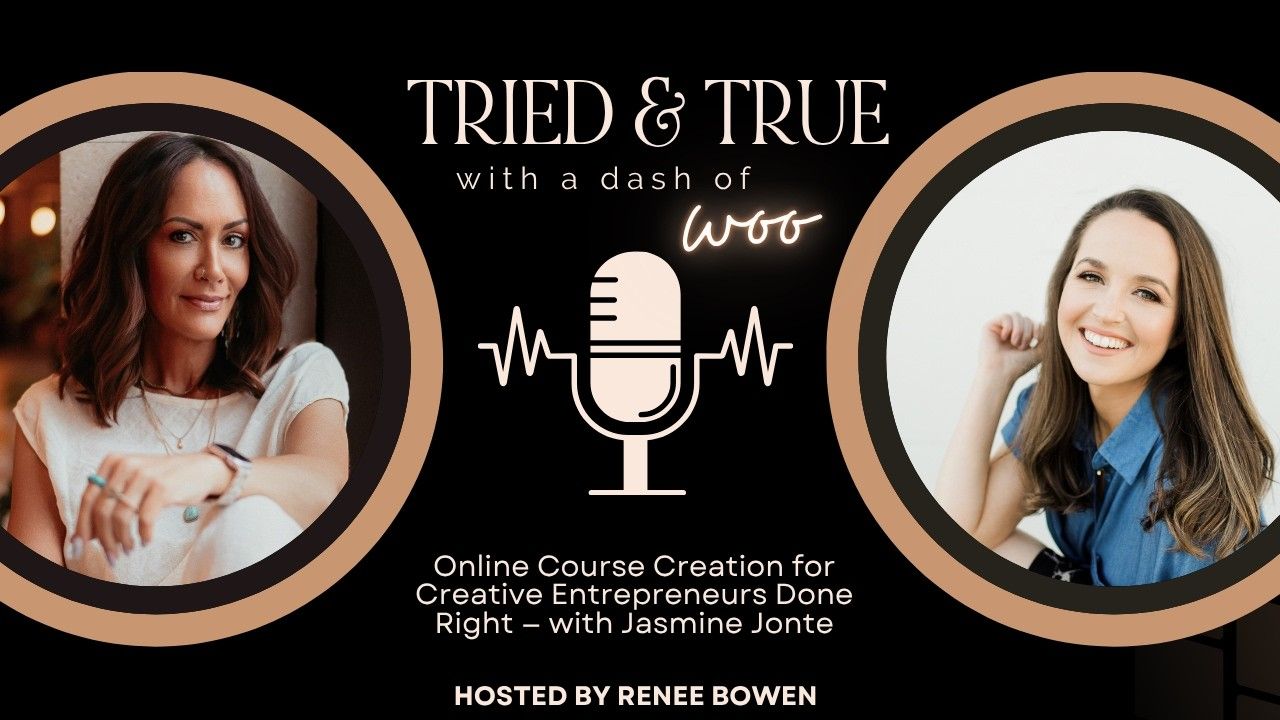
If you're a photographer, coach, or any kind of creative entrepreneur who's ever thought "I could probably teach this... but who am I to do that?" — you're not alone, and you're definitely not wrong to feel the pull.
Jasmine Jonte, founder of Cre8tion, joined Renee Bowen on Tried and True with a Dash of Woo to talk through exactly this: how creative business owners can turn what they already know into a course that actually transforms people — without the overwhelm, the imposter spiral, or the mismatched business model trap.
Here's the conversation, Q&A style. ✨
Q: What's the biggest mistake creative entrepreneurs make when turning their skill into a course?
A: Assuming it fits neatly into the same business model they already have.
Jasmine's example: say you're a family photographer who wants to teach other photographers how to build a family photography business. That sounds like a natural extension — except it's actually a different audience, and functionally, a different business. The skill transfers; the audience and go-to-market strategy don't.
There's a nuance here worth catching, though: if you already have a large built-in audience that's already asking for something adjacent — say, moms who follow you for your photos and also want to know how to take better pictures of their own kids — that's a much easier lift, because you're serving the audience you already have, not starting from zero with a new one.
🎯 The real first question: Who's in your audience right now, and what are they actually asking you for?
Q: How do you actually test whether a course idea is worth pursuing?
A: Jasmine's answer is refreshingly analog: ask your actual audience, then follow up with real conversations.
AI market research has its place — it's genuinely useful for helping you distill and refine your own thinking before you go ask real people anything. But it's not a substitute for talking to humans. Her recommended approach:
- Run polls where your audience already hangs out (Instagram, email, LinkedIn — wherever that is for you)
- Follow up with the people who respond — DM them, or ask for a quick 20-minute call
- Prioritize depth over volume: 10 real, specific conversations with people who'd actually be a fit beat 100 anonymous poll responses where you have no idea who's answering
⚠️ One important boundary: keep market research conversations separate from sales conversations. If someone starts asking to buy mid-research-call, Jasmine's move is simple: "That wasn't the intention for this call — let's talk about that next week." Respecting the purpose of the conversation keeps your data clean and your relationships honest.
Q: How do you get past the "who am I to teach this?" feeling?
A: Jasmine reframes it with a simple analogy: think of expertise like grade levels in school. If you've mastered something, the people coming to you for help aren't kindergartners at your skill — they're more like high schoolers. You don't need to be the world's foremost, all-knowing expert. You just need to know more than the person you're teaching, on the specific thing you're teaching them.
Interestingly, she flips the imposter fear on its head: if someone truly is a total beginner (a "kindergartner"), you might actually be the wrong teacher for them — because you know too much and it's harder to get back down to their level. Everyone is positioned to teach someone at a specific point on the skill spectrum, and that positioning shifts as you grow.
✅ Quick reframe: You're not being asked to be the end-all authority. You're being asked to share the roadmap for the one thing you've already mastered.
Q: What actually makes a course "transformational" instead of just informational?
A: It comes down to one question, and Jasmine repeats it like a mantra: what's going to get my student results the fastest?
She pushes back on a lot of common course-industry dogma here. You don't need a curriculum. You don't need community. You don't need live coaching. Those are all vehicles — sometimes the right one, sometimes not — but the actual goal is the result, not the format. She's personally gotten great results from self-paced programs with zero community, and she's seen "community-first" programs fall flat. There's no single correct delivery format — only the fastest, most aligned path to the specific result your specific audience wants.
Q: What shifts has the course market gone through since everyone piled online in 2020?
A: A lot of saturation, followed by a lot of skepticism — and, in Jasmine's view, a genuinely more sophisticated buyer as a result. People no longer assume information automatically equals transformation. They never actually wanted "a course" in the first place — they wanted a result, and the course was just the vehicle.
Her practical takeaway for creators building today: make it as short as it can be while still delivering the result. Big, sprawling five-course bundles can still work if they're already converting — if it's not broken, don't fix it — but for newer creators without a strong personal brand yet, something small, specific, and tangible (think: log in, spend 45 minutes, walk away with the result) tends to perform better than a massive catch-all offer.
Q: You talk about using human design in course creation — how does that actually show up?
A: This is where the conversation gets uniquely Jasmine. Her team uses human design with clients (and internally with her own team) to understand how someone is naturally wired to make decisions, collaborate, and — crucially — how they instinctively like to learn, because most creators unconsciously build courses shaped around their own learning preferences, assuming everyone else learns the same way.
A few real examples she shared:
- As a "1-line" herself, Jasmine tends to go deep down research rabbit holes and assumes students want the same depth — when in reality, most don't, and that instinct has to be checked before it turns into content bloat.
- Team members with a "sacral" authority often struggle with decision paralysis around "finishing" content, since it feels permanent. Jasmine's repeated internal mantra to her team: "80% is 100%." It doesn't have to be perfect on the first pass — programs evolve.
You don't need to be certified in human design to take the underlying lesson: your natural learning style is not your audience's learning style. Building in some intentional checks against your own bias is worth doing regardless of the framework you use to get there.
Q: How specific should you get when defining who a course is actually for?
A: Jasmine's go-to exercise here is the same one she uses across nearly every client engagement: picture 10 of your most ideal past one-on-one clients. Would at least 8 of them need this specific piece of content to get the result?
If yes, it belongs in the core program. If it only applies to 2 or 3 of them, it's not wrong information — it just doesn't belong in the main path. The real skill in course design, she notes, isn't deciding what to include. It's deciding what to leave out.
Q: Where's the line between using AI efficiently and losing your authentic voice?
A: Jasmine's stance is clear: be your own content source. AI is genuinely useful for fleshing out a concept, asking clarifying questions, formatting, or proofreading — but the heart of a program should come from the creator's own experience, stories, and moments with real clients first.
That's part of why her team still runs in-depth interviews to pull content directly out of a client's brain before layering in any AI assistance for structure. The distinction she draws: AI-assisted is fine. AI-replaced is what creates "AI slop" — content that might generate a quick win but doesn't hold up, because it's missing the specific, lived experience that actually differentiates one expert's teaching from another's.
Q: What's your honest advice for someone who wants to DIY their first course?
A: There's no universal right or wrong here — some of Jasmine's clients DIY successfully, especially when it fits their current season of business and life. But her honest caution: give yourself far more time than you think you'll need.
She shared a recent, sobering example: a friend who DIY'd his course build under time pressure hadn't been on a date with his wife in months and was genuinely burnt out — a real reminder that underestimating the scope of a full course build (marketing, curriculum, video, community, tech) is one of the most common ways creators run themselves into the ground.
Q: What's one piece of advice for someone who feels overwhelmed before they've even started?
A: Own what you actually know. Jasmine recommends a simple but effective exercise: write down everything you've done and everything you're proud of — validate your own expertise on paper before you take any external action. Whether your first step is market research, a pop-up offer, or a scrappy workshop, the energy you bring into that first action shapes the result you get from it.
The Bottom Line
You don't need to be the world's leading authority to build a course that changes lives — you need to know more than the person you're teaching, be honest about who you're actually serving, and design around their needs (not just your own natural learning style). Teaching is a distinct skill, alignment matters more than volume of content, and the fastest path to a result almost always beats the most impressive-looking curriculum.
Curious what your course could actually look like? 🚀 Head to cre8tion.co to grab the services guide or book a call and talk through your idea.
If this conversation resonated, follow along for more real talk on building a business — and a life — that's actually aligned with you.
Join Thousands of Course Creators + Get FREE Weekly Tips in your Inbox
The folks on my list get the goods, by which I mean... insider scoop on the biz, personal life updates, and first chances to join me in new opps. You're in good company. No spam, ever.
We hate SPAM. We will never sell your information, for any reason.
