Take Your Online Course from Good to Great
Feb 08, 2026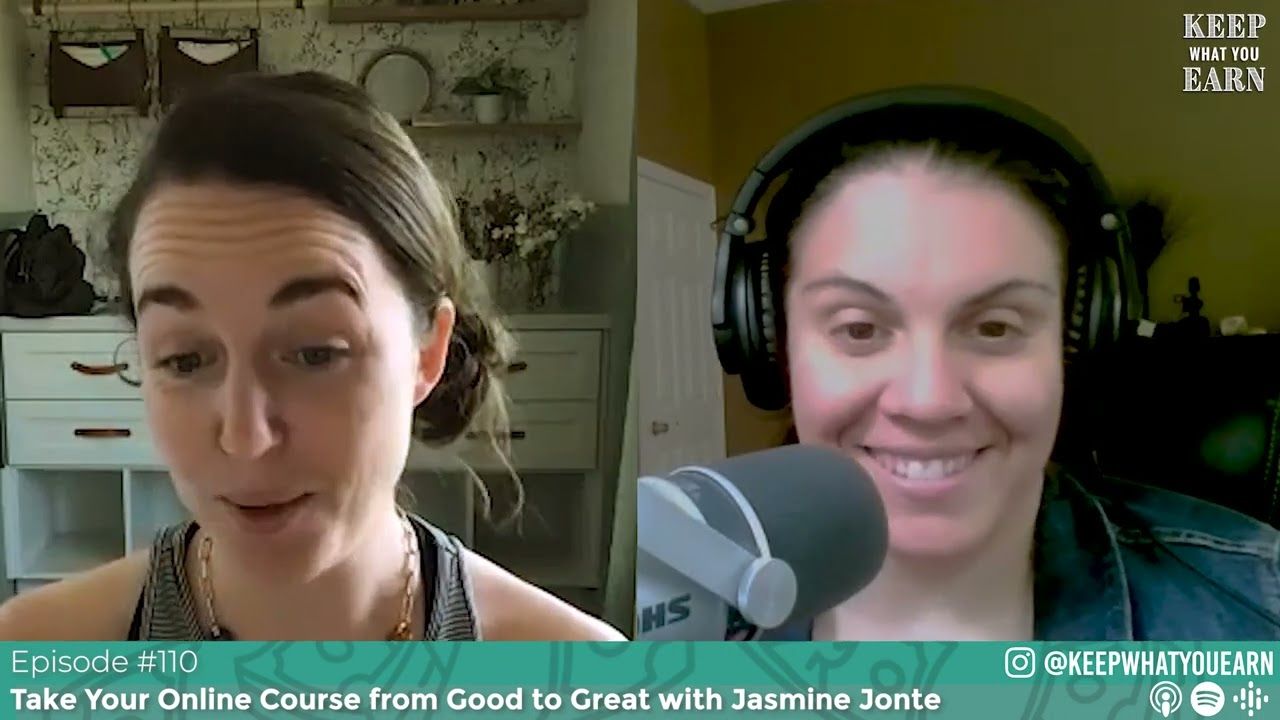
Would you rather pay 2,000 for the same result delivered in 5 hours? Jasmine Jonte, founder of Cre8tion, posed exactly this question to Shannon Weinstein on the Keep What You Earn podcast — and the answer says everything about why "more content" is often the wrong instinct. Let's get into it. 🎯
Q: How do you know when it's actually time to build a course?
A: Only after you've worked one-on-one with enough people to understand the full journey — where they get stuck, what action steps they need, and when they need them. Jasmine's clearest signal: you'll notice yourself repeating the same explanations over and over again. That repetition is the moment to package what you're saying into a resource, rather than continuing to explain it fresh every time.
She also flags a specific readiness marker beyond content mastery: have you refined *how* you explain it? Working with real people over time is how you discover which stories, analogies, and framings actually land — Shannon pointed out she uses a "bajillion analogies" specifically because she's tested which ones stick with real audiences. That refinement doesn't happen without real reps.
Q: Can you teach a second, unrelated topic just because you already have a course platform?
A: Not easily — and Jasmine's analogy is memorable: it's like building a great Mexican restaurant and then deciding to also sell pizza. Even if you're personally skilled at both things, your audience, credibility, and positioning were built around one specific expertise. A tax strategist who's also great at productivity can't simply repurpose their tax-focused audience for a productivity course — that's effectively a different niche requiring its own audience-building from scratch.
Q: What actually separates a good course from a great one?
A: Three consistent factors, according to Jasmine:
- Every lesson has a clear, deliberate action step. Not "here's information" — "here's exactly what to do as a result of watching this."
- Lessons stay short. In a Netflix/Reels/TikTok world, Jasmine sees the best results from lessons in the 5-15 minute range — sometimes as short as 3 minutes, depending on the audience and topic.
- Real deliverables accompany the content — tools, templates, and resources that actively speed up the time it takes students to get results, not just supplementary reading.
Q: How do you actually narrow down what belongs in a course, when there's so much you could teach?
A: Reverse engineering, starting from the transformation itself. Jasmine's process: define the ultimate result first, break that into major milestones, then break those milestones into smaller stepping stones. Working backward from the end result — rather than forward from everything you know — naturally filters out content that doesn't serve the outcome.
💡 A permission-giving reframe worth remembering: most great programs are built to serve 85-90% of students, not 100% of every possible edge case. The remaining 10-15% of "I'm a special snowflake" needs are exactly what live coaching calls or 1:1 support exist for. You don't have to cram every possible scenario into the core curriculum.
Q: Isn't more content generally seen as more valuable, especially at higher price points?
A: This is where Jasmine's thought experiment really lands. Picture two versions of the same course, both delivering the same podcast-launch result: a 50-hour version priced at 2,000. Most buyers will choose the shorter, pricier option — because what they're actually paying for isn't hours of content, it's time saved.
Shannon's framing captures this well: "Usually you're paying more money to save more time... you're not paying more money to invest more time." If a course requires 50 hours of watching on top of the purchase price, that's a double cost — money and time — which undercuts the entire value proposition of buying a shortcut in the first place.
🚀 The bigger philosophy behind this: the purpose of a well-built course is to compress decades into days — and people will pay a real premium for that compression.
Q: What does a well-structured course actually look like, length-wise?
A: Jasmine's current benchmarks, based on what she's seeing work most consistently:
- Signature program length: roughly 4-5 hours total
- Modules: around 45 minutes each
- Individual lessons: 5-15 minutes, sometimes as short as 3
Q: What are some unexpected topics that have made successful courses?
A: Jasmine's examples make a strong case that almost any niche can work if it's built right:
- Immigration law — specifically, a course on obtaining an extraordinary-person visa. Buyers were willing to pay significant amounts because the alternative (hiring a lawyer directly) is so much more expensive — and the creator built in an upsell for a personal review of the work, creating a smart middle tier between fully DIY and fully done-for-you.
- B2B agency knowledge — Jasmine's seen strong success with courses built by consultants, YouTube agencies, and podcast agencies, because running many client projects gives you deep pattern recognition on what typically goes wrong — exactly the kind of nuance that makes a course genuinely useful rather than generic.
⚠️ One important caveat on timing: transitioning from doing the work to teaching it is much easier once you already have credibility and an audience built. Jasmine described a PR agency veteran (with a client roster including major global brands) who could launch a course teaching PR immediately, specifically because she'd spent years building recognition first. Someone without that built-in audience and reputation needs to invest in visibility before a course launch will convert well — the content quality alone isn't enough.
Q: What's the biggest mistake you're currently seeing in how people price, package, or sell their courses?
A: Not having a clear ascension model — knowing explicitly what problem gets created after a student finishes this program, and having a thoughtful next step ready for them.
Jasmine's framing here is worth sitting with: this isn't about aggressive upselling. It's about recognizing that finishing one transformation naturally creates the next challenge, and being prepared to guide students into that next step from a place of genuine service — "I'm here for you, and I've got you for what comes next too." This is also the mechanism behind the third (and most overlooked) way to grow a business: not more customers, not higher transaction value, but more repurchases and referrals from people who already trust you.
Q: How realistic is it to build a course entirely on your own?
A: Jasmine is candid about the actual time investment: a genuinely good course takes around 250 hours to build — which is exactly why she's never built one for herself, despite people regularly telling her she should. She's too busy building programs for other people.
Shannon echoed this from direct experience working with Jasmine's team: dedicated, structured time (in her case, a weekly hour specifically set aside to think through the course) made an enormous difference — comparing it to training with a fitness coach rather than trying to self-motivate alone. Accountability and structured process, not just raw effort, are what actually get a course finished.
The Bottom Line
A great course isn't defined by how much content it contains — it's defined by how efficiently it compresses a real transformation into something students can actually finish and apply. Reverse-engineer from the result, keep lessons short and deliverable-rich, price around time saved rather than hours delivered, and always know what comes next for a student once they've gotten their result.
Thinking about whether now's the right time to build your course? 🚀 Head to cre8tion.co to talk through what your program should actually include.
Enjoyed this conversation? Subscribe to Keep What You Earn for more real talk on building a business (and a course) that actually works.
Join Thousands of Course Creators + Get FREE Weekly Tips in your Inbox
The folks on my list get the goods, by which I mean... insider scoop on the biz, personal life updates, and first chances to join me in new opps. You're in good company. No spam, ever.
We hate SPAM. We will never sell your information, for any reason.
