
The Real Secret to Course Completion Nobody Talks About
Feb 22, 2026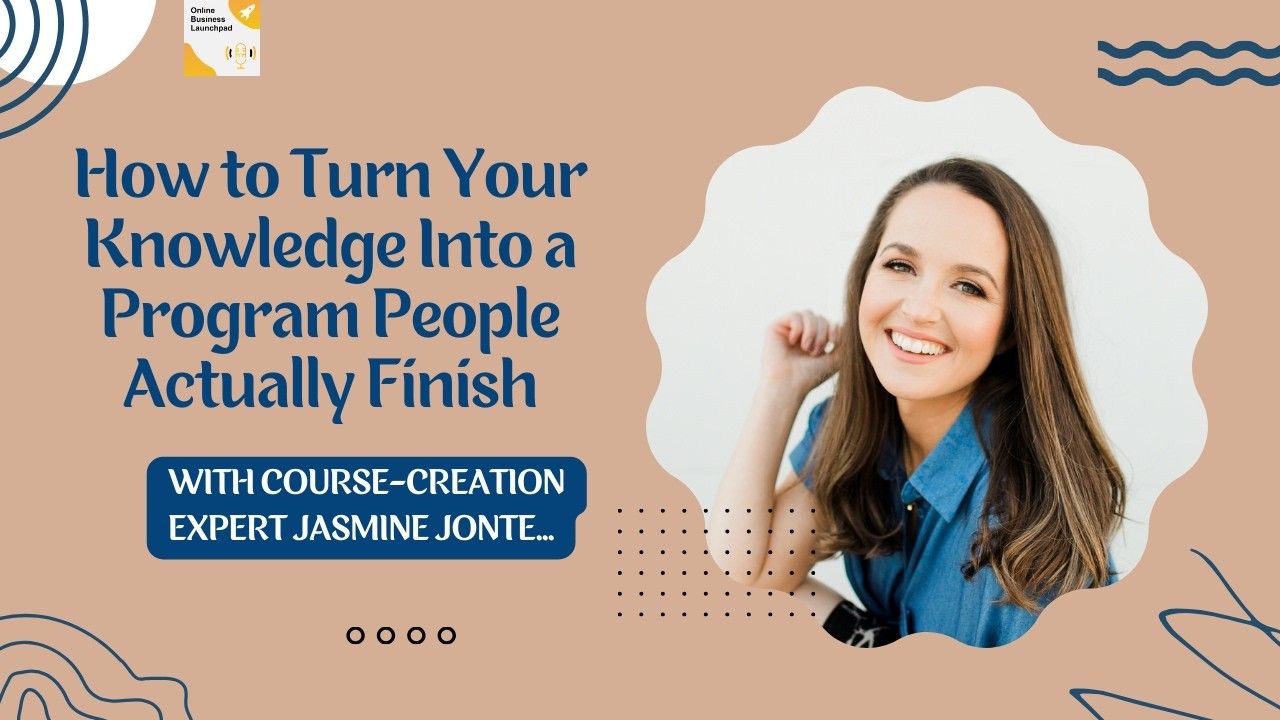
Here's a question worth sitting with: have you ever bought a course from someone clearly brilliant at marketing — and then logged in to find... nothing that actually taught you anything? 🎯
Jasmine Jonte, founder of Cre8tion, has been there. On the Online Business Launchpad podcast with Trudy Rankin, she traced her origin story back to a $7,500 marketing course that changed the trajectory of her entire career — not because it was good, but because it was so bad it revealed a gap she didn't know existed. Let's dig into the conversation.
Q: What actually made you realize there was a business in teaching people how to teach?
A: A genuinely painful $7,500 lesson. Jasmine bought a course from a marketer who, by all appearances, was making serious money online — and logged into a program so poorly built it barely resembled an actual learning experience.
The epiphany that came out of it: just because someone is exceptional at marketing and sales doesn't mean they know how to deliver results once someone's already bought. Marketing is a skill. Sales is a skill. And — the part most experts miss — teaching is a completely separate skill from both.
That gap became the foundation of her entire business.
Q: Do you actually need to be an expert in a subject to help someone build a great course about it?
A: No — and this might be the most counterintuitive (and freeing) insight in the whole conversation. Jasmine explains that instructional design and learning experience design are transferable skills. You don't need deep subject-matter expertise to help someone structure and deliver their knowledge effectively — you need the skill of extracting wisdom from an expert and shaping it into something learnable.
It's part of why her team can move fluidly between wildly different niches — from tarot education to real estate investing to cosmetic dentistry — using the same underlying methodology each time, regardless of subject matter.
Q: How important is relationship-building for experts trying to turn knowledge into a business?
A: More important now than ever, in Jasmine's view — specifically because of AI. As more content becomes AI-assisted or AI-generated, reputation and realness become the actual differentiator. How you show up and relate to people is what people are increasingly looking for and drawn to, not just information itself.
Q: What does "asking good questions" actually look like in practice — especially during early market research?
A: Jasmine's answer here is refreshingly concrete. Surface-level questions like "What keeps you up at night?" or "What are you struggling with?" are a fine starting point — but the real insight comes from the follow-up question.
Her example exchange:
"What are you struggling with right now?" "Lead gen's really hard for me right now." "How so?" "I'm trying LinkedIn and it's just not working." "Tell me more."
💡 The pattern: keep gently pulling the thread until you reach the full, clear picture — not just the first thing someone says. AI-generated market research can help you narrow down which questions to ask multiple ideas against, but Jasmine is clear that nothing replaces an actual one-on-one conversation with a real, ideal client once you've honed in on a direction.
Q: How many different industries does your team actually work across?
A: At the time of this conversation, somewhere between 15 and 18 broad niches — spanning tarot education, real estate investing, PR and influencer marketing, and cosmetic dentistry, among others. Across more than 140 programs built, Jasmine's team has tracked at least 70 distinct sub-niches.
The through-line isn't subject expertise — it's a repeatable methodology for helping any expert get their one-on-one results to translate into a scalable, teachable format.
Q: Walk us through what actually happens when an expert comes to you for help.
A: Jasmine's team follows a consistent five-phase process:
- Evaluate — What does the client already have? Presentations, keynote recordings, group coaching footage, even a published book — anything that represents existing body of work.
- Marketing (map the offer) — How will this expertise be productized, and how does it fit into the client's current business model?
- Architect — Build the outline and unique framework/methodology — essentially the blueprint for what needs to be built.
- Build — Interviews to extract the expert's specific wisdom, then scripts, workbooks, AI tools, and all supporting assets get built before video production begins.
- Video + Upload — Final production and placement into whatever platform the client uses (Kajabi, Thinkific, Teachable, Circle, etc.).
Worth noting: Jasmine's team deliberately doesn't handle marketing execution. They build the strategy and hand it off to the client's own team or channel specialist — acting as the connective tissue between product development and marketing, rather than trying to be a full-stack agency. As she put it, a lot of creators struggle because there's no "quarterback" between the people building the course and the people marketing it — this structure solves for exactly that gap.
Q: You went from solo teacher to running a 14-person team. What was that transition actually like?
A: Jasmine frames it as one of two real choices experts eventually face once they're fully booked: build a team to deliver the service, or productize the expertise into leveraged offers. She's done both — running an agency team and helping her own clients build leveraged programs.
The identity shift required to build a team, she notes, is real: "You kind of have to kill off parts of your identity every time you bring on a team member." The instinct to believe "no one else can do this the way I do it" is common — and often simply untrue.
Her specific hiring strategy is worth stealing: she hires teachers. People coming out of the classroom (or looking to transition out of it) tend to be organized, high-integrity, and genuinely care about the end learner — which turns out to be exactly the mindset needed to build great learning experiences for someone else's students.
Q: How does your team actually use AI day to day?
A: Jasmine describes her company as "AI-friendly," not "AI-first" — treating it as a creative partner and rough-draft generator rather than a replacement for original thinking. A few tools she named specifically:
- ChatGPT — the team's primary LLM, with several internal systems built around it
- Descript — used for video editing, both internally and for client projects
- Senja — an automation tool (not strictly AI) for collecting and auto-publishing client and team testimonials to a website and social channels, organized by client profile
The bigger point behind the tools: AI hasn't been used as a shortcut so much as a way to create space for more creative, higher-quality work. Jasmine notes that in 2024, her team was manually typing every line of every video script — hundreds per year — which left far less room for creative refinement than they have now.
Q: What's the one thing you wish more people understood before choosing this path?
A: A genuinely important reality check: to succeed in the online course/leveraged-offer world, you have to either become or hire a digital marketer.
When you're working one-on-one, you need relatively few leads to sustain a high-ticket, low-volume business. The moment you shift toward a leveraged, more scalable offer, you typically need dramatically more leads — sometimes 100x more — to hit the same revenue. Jasmine's blunt summary: "Most people don't think they can build a course and sit with mimosas on the beach while their PayPal dings — and that's just not how it works."
⚠️ The takeaway: decide upfront whether you're going to build that marketing skill set yourself or bring in someone who already has it — before you've built the entire program and are left wondering where the students are.
The Bottom Line
The real secret to course completion isn't a hack — it's recognizing that teaching, marketing, and subject-matter expertise are three separate skills, and building (or hiring for) all three intentionally. Ask better follow-up questions in your research, build your team around people who genuinely care about the end student, and go in with eyes open about what it actually takes to get your program in front of the right people.
Want to see how your own expertise could translate into a program people actually finish? 🚀 Head to cre8tion.co, grab the free guide on making your course as binge-worthy as Netflix at cre8tion.co/netflix, or chat with Jasmine's custom-trained GPT for instant feedback on your own program.
Enjoyed this episode? Subscribe to Online Business Launchpad for more real conversations on building the online side of your business.
Join Thousands of Course Creators + Get FREE Weekly Tips in your Inbox
The folks on my list get the goods, by which I mean... insider scoop on the biz, personal life updates, and first chances to join me in new opps. You're in good company. No spam, ever.
We hate SPAM. We will never sell your information, for any reason.
