
The Secrets to Create a Course That Sells and Transforms
Feb 14, 2026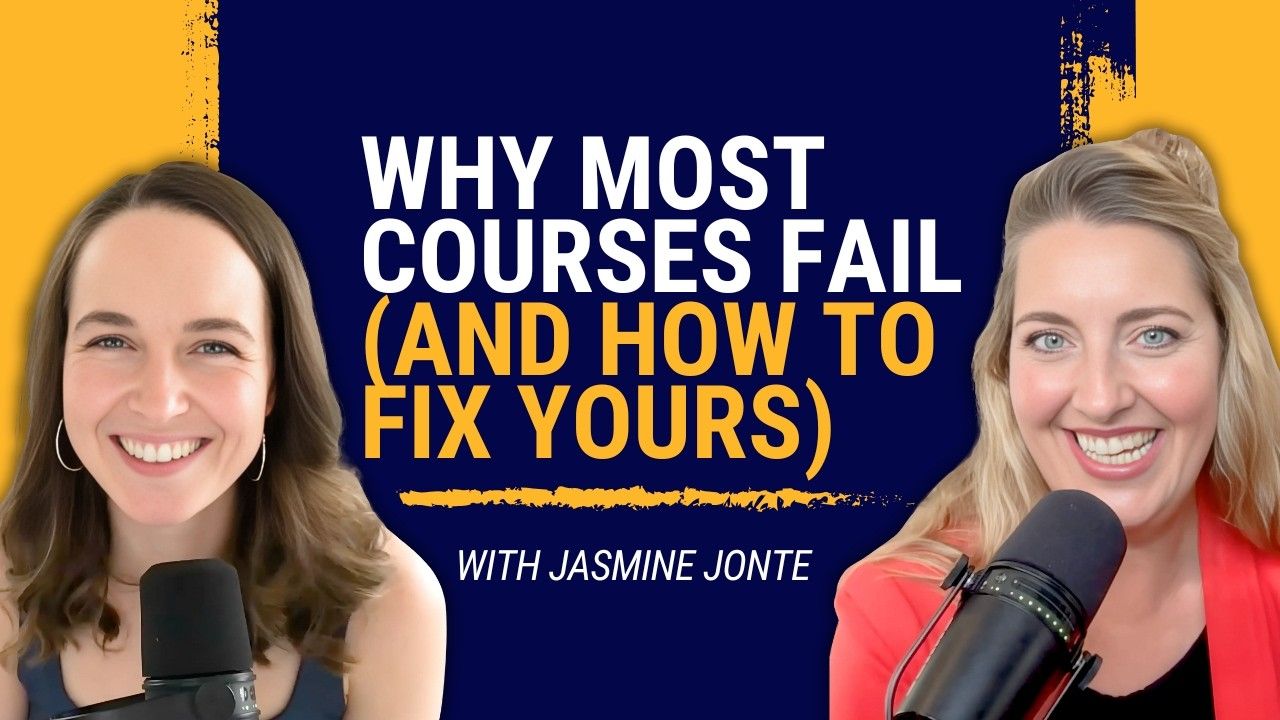
The average online course completion rate is around 3%. Jasmine Jonte, founder of Cre8tion, shared that number with Jennifer Jimenez on The Abundant Coach podcast — not to be discouraging, but to make a point: there's a real gap between courses that just exist and courses that actually transform people. Here's how she thinks about closing it.
Q: What are the most common mistakes course creators make, regardless of business size?
A: After auditing what Jasmine describes as more programs than she can count — from solo creators to multi-million-dollar thought leadership businesses — two mistakes show up consistently at every level:
Over-indexing on how much students actually want to learn
As the master of your craft, you've read every book, chased down every nuance. But most students aren't coming for mastery — they're coming for a result. Including everything you know isn't generosity; it's actually a disservice, because it buries the specific path to the outcome they signed up for.
Not making content actionable enough
Theory without a clear next step doesn't move people forward. Jasmine's fix is specific: after telling students what to do, also define what "done" looks like — and what the standard of success is. Not just "did you complete the task," but "did you complete it successfully."
✅ Quick gut-check: Would a student reading your lesson know exactly what action to take next, and how to know they did it right?
Q: Why does defining "what success looks like" matter so much?
A: Because many students — especially high-achieving, self-critical ones — will complete a task and still feel like they haven't "done it right." Jennifer shared her own experience coaching driven women who consistently downplay genuine wins in group Q&A sessions. Jasmine's framework directly counters this: explicitly telling students what a real win looks like — including warning them that their inner critic might show up afterward and tell them it wasn't good enough — gives them permission to actually claim the progress they made.
Q: Can you walk through your "Course Flow to Cash Flow" framework?
A: Jasmine returns to her familiar filing cabinet metaphor: your expertise is like 100 files in a cabinet. The goal of any program is identifying the roughly 10 files that 80% of your students actually need, then sequencing them correctly.
Here's the nuance worth catching: the order you personally learned things in isn't necessarily the fastest order for someone else to learn them. When you were doing something for the first time, you made mistakes, doubled back, took detours. A framework is your chance to plant a flag for the more direct, efficient path — informed by your own trial and error, but not identical to it.
Her five-step process:
- Evaluate — What existing assets do you already have? Blog posts, podcast episodes, a book — anything leverageable.
- Architect — Map the course outline and framework (the "10 files," in the right order).
- Build — Write scripts, build slides and workbooks — everything that goes into the actual curriculum.
- Video — Record and edit.
- Upload — Get it into the platform.
🎯 The reassurance underneath the framework: building a course feels overwhelming as one massive project. Breaking it into these five discrete phases — each with its own smaller dependencies — is what actually makes it achievable.
Q: How should coaches actually be using AI in course creation right now?
A: Two distinct applications, according to Jasmine:
Speed
AI can genuinely accelerate output — but only if you know how to ask it strong questions. Her caution here matters: AI is trained on the internet, and the average course completion rate across that training data is roughly 3%. If you're leaning on AI without strong direction, you're essentially drawing from content that, on average, doesn't get results. Jasmine's team builds internal tools trained specifically on their own methodology and client material — not general internet content — for exactly this reason.
Personalization at scale
This is where Jasmine gets genuinely excited. Her example: imagine a coach who leads students through visualizations or meditations. What if AI could generate a custom visualization, in the coach's own voice, personalized to each individual student — without the coach recording a single new file? That kind of personalization would be logistically impossible to deliver manually across hundreds or thousands of students, but AI makes it realistic.
⚠️ Her forecast: implementing this kind of personalized AI tooling puts you ahead of the curve today. Within 18-24 months, she expects it to become table stakes — something students simply expect, not something that differentiates you.
Q: If someone already has a course, what does "optimizing" it actually look like?
A: Jasmine notes something reassuring here: coaches, as a group, tend to already build fairly solid programs — since coaching itself is a helping profession, the instinct to genuinely serve students is usually already present. Her most common interventions when auditing and revamping existing programs:
- Cutting content — often more than people expect
- Upgrading specific pieces rather than rebuilding everything
- Adding AI tools where they'd genuinely help
- Migrating platforms if the current user experience is holding students back
- Strengthening support structures around the curriculum — re-engagement campaigns, improved onboarding, more facilitated or peer-networking elements
The underlying goal isn't more content — it's a deeper, richer transformation experience.
Q: How do you actually make a course fun without sacrificing substance?
A: Jasmine is upfront that gamification, on its own, is secondary to solid instructional design. Her memorable comparison: gamification without good teaching underneath it is like those pedal-powered party bikes you see touring cities — everyone's having a great time, but nobody's actually getting anywhere fast.
Where she sees real value is in what she calls edutainment — infusing the coach's actual personality and cultural references into the teaching itself. Her concrete example: a confidence-building course where, instead of just talking about confident posture, her team pulled iconic clips of Wonder Woman embodying it. The result stuck with students specifically because it attached new information to something they already knew and remembered — most women have seen Wonder Woman, so the concept became instantly memorable rather than abstract.
💡 Simple, replicable tip: ask what TV shows, movies, or cultural touchpoints your specific audience already loves, and find ways to illustrate your teaching through those references — even a meme can do real work here. AI can now help surface relevant clips quickly, making this more accessible than it used to be.
Q: Any final piece of advice for someone building or scaling a course right now?
A: Recognize your achievements — even the small ones. Jasmine's closing thought reframes the pressure many creators put on themselves: a single Instagram post that only reaches two people can still genuinely change someone's day — and that ripple effect (a better mood, a kinder interaction, a better day for someone else down the line) is real, even if it's invisible from the outside. Rather than operating from a constant "hustle, hustle, grind, grind" mindset, taking a breath to acknowledge what you're already doing creates a healthier foundation to keep building from.
The Bottom Line
The gap between a 3% completion rate and a genuinely transformational course comes down to a few consistent things: teach only what students actually need (not everything you know), make every step explicitly actionable with a clear definition of success, sequence your content for the fastest path — not the path you personally took — and don't underestimate the power of a little fun woven intentionally into real instructional design.
Ready to turn your expertise into a course that actually delivers? 🚀 Grab Jasmine's free guide, 10 Next Level Strategies to Make Your Course as Binge-Worthy as Netflix, or head to cre8tion.co to learn more.
Enjoyed this conversation? Subscribe to The Abundant Coach for more strategies to grow your coaching business and your impact.
Join Thousands of Course Creators + Get FREE Weekly Tips in your Inbox
The folks on my list get the goods, by which I mean... insider scoop on the biz, personal life updates, and first chances to join me in new opps. You're in good company. No spam, ever.
We hate SPAM. We will never sell your information, for any reason.
