Why Most Online Offers Don't Work — And How to Build Experiences People Want
Apr 05, 2026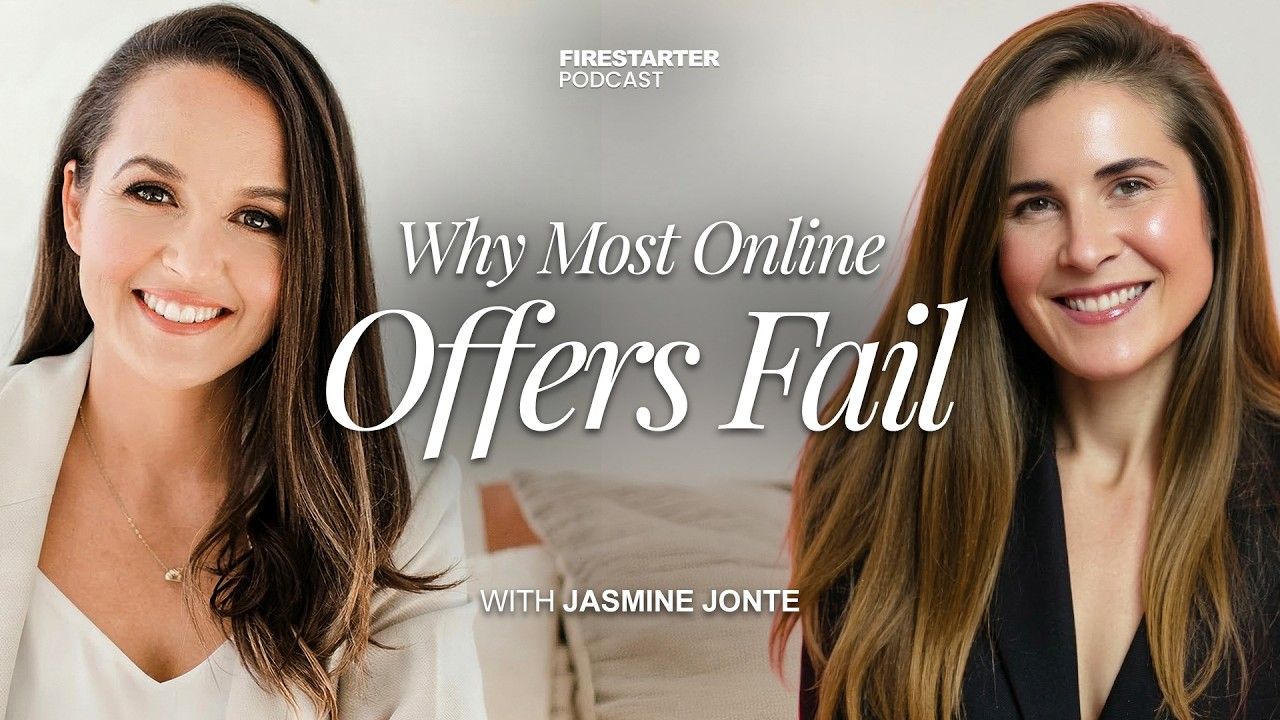
Every online space has its noise: challenge launches are the only way, beta launches don't work, courses are passive income. Jasmine Jonte, founder of Cre8tion, has heard it all — and on the Firestarter Podcast with Willa Kammerer, she pushed back on nearly every one of those absolutes.
Here's the conversation, broken down. 🎯
Q: What's the single biggest mistake experts make when building an online offer?
A: Forgetting to make it actionable.
Jasmine points out something easy to overlook: in a one-on-one setting, you can read the room. You see confusion on someone's face, and you adjust in real time. In a course — where you can't see the person on the other end — that missing feedback loop means your content has to be more actionable than it would ever need to be in person, not less.
Her fix is reverse engineering from the transformation backward: what specific actions does the student need to take? Are the lessons aligned with those actions? Are the modules aligned with the lessons? Is the whole structure actually pointed at the big transformation, or just adjacent to it?
✅ Quick gut-check: if you removed all the "nice to know" context from your course and kept only the action steps, would a student still be able to get the result?
Q: What's the second big mistake you see?
A: Mismatching the transformation with the support structure around it.
Group coaching, certification programs, online communities — these all exist for good reasons, but Jasmine is clear that the format has to match what the transformation actually requires, not just what's trendy in the industry at the moment. A high-stakes, emotionally complex transformation might need live coaching touchpoints. A more mechanical, skill-based transformation might not need community at all. Defaulting to whatever container is popular right now, without checking it against what your specific students need, is where a lot of good expertise gets buried in the wrong wrapper.
Q: Sometimes the "right" answer isn't even a course. How do you know?
A: This came up directly in the conversation — Willa herself worked with Jasmine on what started as a course idea, and ultimately realized the better fit for her clients was personalized, one-on-one implementation coaching, not a course format at all.
Jasmine's broader point: you don't have to build a course to get leverage in your business. The real starting question isn't "should I build a course?" — it's "what does my ideal client actually need to get the result, and what container serves that best?" Sometimes that's curriculum. Sometimes it's hands-on delivery. Sometimes it's a hybrid.
Q: With AI making it easier than ever to launch a course, how does the market actually shift?
A: Jasmine's take is refreshingly non-alarmist: easier entry means more noise, but it also means more discernment from buyers.
As AI lowers the barrier for anyone to call themselves an expert and throw a program online, client sophistication rises right alongside it — people have been burned by bad programs before, and they're more selective now. Her framing: "The cream will rise to the top." For creators who genuinely have the goods, this is good news — it gets harder to fake it, which means real expertise stands out more, not less.
On the student side, she sees a clear upside too: AI-powered tools inside programs can help students implement faster and get results faster — meaningfully improving the actual value delivered, not just the marketing around it.
Q: A lot of people feel urgency to "just launch the course already." What gets missed when they rush?
A: Readiness, mostly. Jasmine estimates that at least half of the people who come to her aren't actually ready yet — not because their expertise isn't real, but because they haven't taught enough people yet to have the data points needed to productize effectively.
Her non-negotiable minimum: at least 10 people, one-on-one or in a consulting capacity, with the result already proven. Without that, creators end up building on guesses instead of patterns — and then wonder why they're "spinning" once the program is live.
Q: Build-first or launch-first — which is the right approach?
A: Neither, universally — Jasmine has seen both work, and she resists the idea that there's one correct sequence.
- Build everything, then launch: works well for people who feel more confident selling something they're already proud of.
- Launch (beta), then build: works well for people who'd rather validate an offer converts before investing heavily in production.
The right choice depends on your audience size, personal brand maturity, and — importantly — your own strengths and confidence level. There's no universally superior path; there's only the path aligned with where you and your business actually are right now.
Q: What about all the "one right way to launch" advice out there — challenge launches, webinar funnels, etc.?
A: Jasmine calls this a personal red flag. Whenever she hears someone claim there's one best way to launch — webinar funnels, challenge launches, evergreen ads, JV partnerships, YouTube SEO — her instinct is skepticism. The market has become too sophisticated for single-path thinking. There are legitimately many valid traffic and conversion strategies, and the right one depends on the specific offer, audience, and creator — not a universal formula.
Q: What are the real readiness markers before someone builds an online course?
A: Three, according to Jasmine:
- Proven one-on-one results with at least 10 people. Non-negotiable — this is where the real pattern recognition and content decisions come from.
- Willingness to become (or hire) a digital marketer. The idea that courses are truly passive income is, in her words, a myth she's over correcting. Even the most passive channels — like SEO — require ongoing activity to sustain results. If a course genuinely seems to run itself, there's very likely a team behind the scenes running marketing continuously.
- Comfort with iteration and imperfection. A course isn't a finished artifact — it's a living body of work that evolves as you evolve. Waiting for it to feel "done" before launching means it never launches.
💡 The reframe worth remembering: iterating on a program later isn't a sign something went wrong — it's a sign you're getting real feedback and continuing to improve, which is exactly what should happen.
Q: How should someone decide between a done-for-you course, a hands-on service model, or something in between?
A: Alignment with the founder, not industry pressure. Jasmine's own choice is a good example — she deliberately built a done-for-you agency model instead of a big personal-brand course business, because deep, hands-on client work is what genuinely energizes her. That choice gave her a team-based business she can step away from (she references taking a two-week vacation while revenue continues) — a different kind of leverage than a solo-creator course business, but leverage nonetheless.
The underlying principle: there's no universally "better" business model — only the one that matches what actually lights you up and lets you sustainably deliver results.
The Bottom Line
Most online offers fail not because the expertise behind them is weak, but because the format, the support structure, or the timing doesn't match what students actually need — or because the creator wasn't truly ready to productize yet. Make it actionable, match the container to the transformation, prove it with real people first, and expect it to keep evolving after launch.
Wondering whether your idea is ready to become a course — or something else entirely? 🚀 Head to cre8tion.co to talk through what actually fits your business.
Loved this conversation? Subscribe to the Firestarter Podcast for more real talk on building brands and businesses that last.
Join Thousands of Course Creators + Get FREE Weekly Tips in your Inbox
The folks on my list get the goods, by which I mean... insider scoop on the biz, personal life updates, and first chances to join me in new opps. You're in good company. No spam, ever.
We hate SPAM. We will never sell your information, for any reason.
