How Do I Go From a $2,000 Program to a $10,000 One?
Oct 20, 2026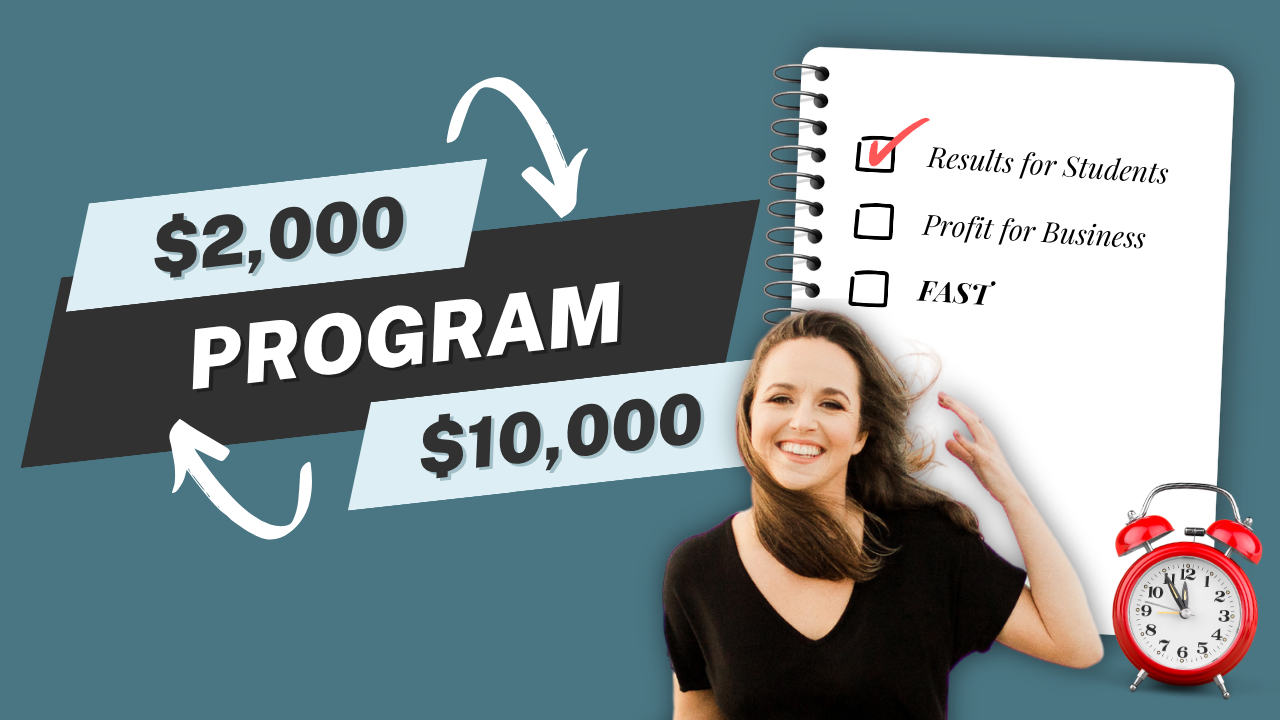
Key Takeaways
- A $10,000 program is not a $2,000 program with a bigger number on the checkout page. Four things change: the outcome you promise, the buyer you promise it to, the container you deliver it in, and the support that makes the result likely.
- Price follows the result, not the hours. "They're not paying you for your time. They're paying you for a result."
- "High ticket" is relative to the buyer's world. $10K means something different to a solo practitioner than to a business owner doing north of $500,000.
- Raising the price usually means cutting content and adding guidance. The programs that justify $10K are shorter, more supported, and harder to buy than the $2K version.
- The fastest route is a time-bound, guided cohort or certification sold to people you've already delivered results for, not a self-paced course sold to strangers.
- Your method can have a second buyer who isn't in your audience: organizations that license it by the seat. That's a parallel channel, not a price increase.
The honest answer is that you don't raise the price. You change what's being bought. A tax-strategy educator came to CRE8TION selling a low-four-figure program where nine out of ten buyers never acted on it, and asked exactly this question: how do we go from a $2,000 ticket to a $10,000 ticket? The answer wasn't a bigger sales page. It was a different offer: a time-limited certification with guided, high-touch support, built for the buyers who would use it. It sold. Here's what moves when you make that jump.
Why doesn't a higher price work on the same program?
Because the $2,000 version is usually priced on content, and content is the thing buyers trust least right now.
Jasmine Jonte, CRE8TION's founder, is blunt about this with clients: more is not more anymore. People can get information anywhere. What they'll pay five figures for is a process that gets them a specific result, with someone making sure they get there. If the program is "here are 40 videos," adding a zero to the price just adds a zero to the refunds.
The reframe that moves most experts out of hourly thinking: "They're not paying you for your time. They're paying you for a result." Once the price is attached to the result, the question becomes what result is worth $10,000 to whom, and what has to be true for them to get it.
Who is the $10,000 buyer?
Someone for whom the result is worth far more than $10,000, in their world.
That last phrase matters. Jasmine's example on discovery calls: "$10K in the spiritual space is very high ticket. $10K in the B2B space for a business owner doing north of $500,000, not so high ticket." The same program can be unaffordable to one buyer and a rounding error to another.
So the first move isn't pricing. It's deciding which slice of your audience you're building the $10K version for. Usually it's the people who already paid you the most, got the best results, and asked what else you have. Build the offer for the buyer, then price it against what the result is worth to them.
What does the $10,000 container look like?
Shorter, time-bound, and guided. The $2K version is typically more self-paced and open-ended. The $10K version has a start date, an end date, and a person in the room.
Three things CRE8TION changes when a program moves up a tier:
- The content gets cut. In many programs, the team takes what the expert has and cuts it in half, and students get better results. A $10K buyer isn't paying for volume; they're paying for the shortest path. That is how Kevin Amell's 21-day options course was built: the beginner program got firm boundaries, and the advanced material was held back for the next offer instead of crammed into the first one.
- Live delivery gets designed, not added. A weekly call bolted onto a self-paced course isn't a cohort. A cohort anchors each live session to a milestone, so the group is working on the same step at the same time. That structure is what makes the price feel obvious to the buyer. Tanya Waymire's No-Pitch Path was built this way: a three-phase program with an ascension path into a premium community tier, and a 100-seat goal for the first cohort.
- The bespoke part is explicit. Every method has pieces that can be built once (video, templates, tools), pieces that need a room (group calls, community), and pieces that need the expert's judgment on one person's situation (audits, 1:1 calls). The $10K version keeps a defined amount of that last category. The $2K version has none.
There's also a reason to do this that has nothing to do with price. Self-paced programs tolerate the least error, because nobody is there to catch a stuck student. A guided cohort tolerates the most. If you're moving up-market, moving toward live delivery is the safer bet, not the riskier one.
How do I know the market will pay it?
Sell it to people you've already gotten results for, before you build the new version.
One of CRE8TION's clients, a coach with eight years of one-on-one work behind her, was skeptical about selling a $5,000 program. Once the pricing was confirmed against her market, she said she felt confident it was aligned with industry norms, and she took it to market. The confidence came from checking the price against the buyer's world and the result, not from a gut feeling. Then, she made 6 figures.
Your first buyers at the new price are your past clients, your waitlist, and the people who said no to your 1:1 because they couldn't fit it or afford it. Offer the new container to them first. Three to five yeses is proof. If nobody says yes, you learned that in a few weeks instead of after a four-month build.
What if people already bought the $2,000 version?
Keep it, or fold it in as the entry point. The two offers aren't in competition if they do different jobs.
A common structure: the $2K program becomes the on-ramp, the $10K cohort or certification becomes the signature offer, and the people who finish the on-ramp and want more are your warmest buyers for the next tier. That's an offer ecosystem, not a price increase, and it's what CRE8TION maps during the strategy phase before any program gets built. Idalia Salsamendi's case study shows what it looks like when low-ticket, mid-ticket and premium offers are connected into one path instead of competing for the same buyer.
Is there a $10,000 buyer who isn't in my audience at all?
Often, yes. Universities, corporations, associations and practices buy methods by the seat, and the ticket is big because it covers a group, not a person.
Not every expert's primary avatar is a $10K buyer. A subset always is, and that subset is where the cohort above comes from. But there is frequently a second buyer who has never been on your list: the organization that wants your method for its people. A corporate team that needs the sales training. A university that licenses the entrepreneurship course. A clinic that wants every associate dentist trained the same way. These buyers pay for the result across twenty or two hundred people, and they are used to five- and six-figure invoices for that.
Two things make a method licensable. First, it has to run without you in the room: structured modules, a facilitator's guide, workbooks, so a manager or instructor can deliver it. Second, the pieces have to be modular enough to buy separately or as a suite. Amy Reczek's sales training was built that way from the start, and the same program now sells to solo sales professionals for themselves and to teams for their salespeople. John Bradberry's entrepreneurship course is licensed through a university.
Certification is a cousin of licensing, not a twin. Sometimes the people who go through the cohort with you want the credential so they can deliver your method to their own clients. Sometimes they just want the result, and the credential means nothing to them. Jonny Stevens' composite dentistry program was built to carry both: dentists learn the skill for their own practice, and the certification pathway is what makes it a platform instead of a one-off course.
Treat licensing as a parallel channel, not an upgrade to the cohort. It has its own buyer, its own sales conversation, and its own delivery format. The method is the only thing both channels share, which is why it has to be named and structured before either one can be sold.
The question to ask before you redesign anything: what would have to be true for someone to pay five times more and be glad they did? Answer that in writing. If you want someone across the table while you do it, book a discovery call.
Common Questions
Is my course priced too low?
If buyers finish it and get the result, and you're turning people away or exhausted, yes. If buyers aren't finishing or acting on it, the price isn't the problem; the design is. Fix completion first (here is what that looked like for a program sitting at 33 percent average progress), then raise the price against the result.
How do I price a group program when I've always charged by the hour?
Stop pricing the hours. Price the result for the buyer in front of you: what is it worth to them, in their world, to have this solved? Then check that number against what similar buyers pay for similar outcomes in their market. A $10K program is cheap for a business owner who makes $50K from it and expensive for someone who can't use it.
Should the $10,000 version be a cohort or a certification?
A certification when the buyer wants a credential they'll use with their own clients or employer. A cohort when they want the result for themselves. Both are time-bound and guided; the difference is what they walk away holding.
Can I license my program to a company or a university?
Yes, if it runs without you in the room and the pieces can be bought separately or as a suite. Licensing is a parallel channel with its own buyer and its own sales conversation, and it usually pays per seat rather than per person. Build the facilitator's guide and workbooks into the program from the start so the door is open.
Join Thousands of Course Creators + Get FREE Weekly Tips in your Inbox
The folks on my list get the goods, by which I mean... insider scoop on the biz, personal life updates, and first chances to join me in new opps. You're in good company. No spam, ever.
We hate SPAM. We will never sell your information, for any reason.
